
How Aurora Residents Are Found
A useful Aurora residents directory search starts with one record that answers one narrow question. The assessor ties an address to a parcel and a tax-roll owner. The voter lookup tests a name, birth date, and ZIP against a registration. A recorder index shows parties to a recorded instrument. A city permit or public-document row can place a business, project, or parcel in time. Older directories, newspapers, census schedules, and museum collections can put a person at an address in an earlier era. None is a list of everyone. No single source is a census of Aurora.
The strongest trail keeps the record type visible at every step. An assessor mailing line is not proof of residence. A voter match is not a household roster. A docket row is not a case file, and an obituary is not a death certificate. Start broad enough to land in the right county. Then narrow by parcel, legal description, or date. Source images settle the rest. The same discipline serves a current question and a family-history search for a former Aurora address.
Use this five-step starter workflow when the clue is incomplete:
- Run the address through the Aurora property map and note the county, parcel ID, subdivision, lot or block, annexation, and public-document clues.
- Test a known name in the Colorado voter lookup with First Name, Last Name, DOB, and residential ZIP, then record only the public fields needed for the question.
- Move to the correct county assessor and recorder. Use the parcel identifier or legal description before relying on a street number or a name-only deed search.
- For an older resident, compare the Library of Congress Aurora telephone run, local directory citations, newspapers, census years, and archive finding aids.
- If a needed record is not online, send a specific request to the custodian with the address, parcel, case, date range, or document number rather than asking for an open-ended person search.
Aurora Resident Records Offices
Aurora's paper trail splits across counties. Arapahoe County holds the largest share of the city, while Adams County and Douglas County also contain Aurora parcels. The county seats sit outside the city: Littleton for Arapahoe, Brighton for Adams, and Castle Rock for Douglas. An Aurora address, ZIP, or last line is a routing clue, not proof of the custodian. Check the county in the city property map or county GIS before reading a negative result as meaningful.
The Arapahoe County public-records contacts page is the practical handoff for assessor and Clerk and Recorder questions. Arapahoe posts assessor@arapahoegov.com and 303-795-4600 for the assessor, plus clerk@arapahoegov.com and 303-795-4200 for the Clerk and Recorder. County offices are open Monday through Friday from 8 to 4 effective January 1, 2026, with some in-person services requiring appointments, per the office-hours page. Adams and Douglas records take their own assessor, recorder, election, or court route.
Arapahoe Clerk and Recorder
County real-property index and recording office
Arapahoe County, Colorado
303-795-4200
Arapahoe Assessor
Parcel, owner, situs, and mailing fields
Arapahoe County, Colorado
303-795-4600
Colorado Elections Division
Statewide voter match and data-request route
Denver, Colorado
303-894-2200
Aurora Directory Map Starts the Route
The Aurora Property Information map is the best first router for a city-limit address. Its autocomplete wants the street direction first. Type E, N, or S, with no period. The map covers only addresses inside Aurora city limits. Once an address is selected, Full Map opens the wider city GIS context. The property categories then expose the county, parcel ID number, lot, block, plat page or quarter section, subdivision name, subdivision case number, and annexation ordinance. Zoning, Title 32 metro district, urban renewal area, trees, and public documents tied to the address or plat round it out.
One address surfaces a dense clue set. Expect business-license fields, building permits, HOA name, and neighborhood coordinator details. Code-enforcement contact, police area, and fire station appear too. School assignments, ward, mayor, and council district come with them. Those fields tell you which office to call. They also show which record key to carry forward. They do not create a public household list. A permit applicant may be a contractor, a business, or another party entirely. The map's search control and property-card behavior shift with use. Treat the stable fields as routing evidence, not a sample result.
The map's address field wants the direction prefix that the Arapahoe assessor form tells users to leave out. That small conflict is a useful Aurora search clue. City map first, county parcel second. The official Aurora Property Information map page carries the full property-map route.
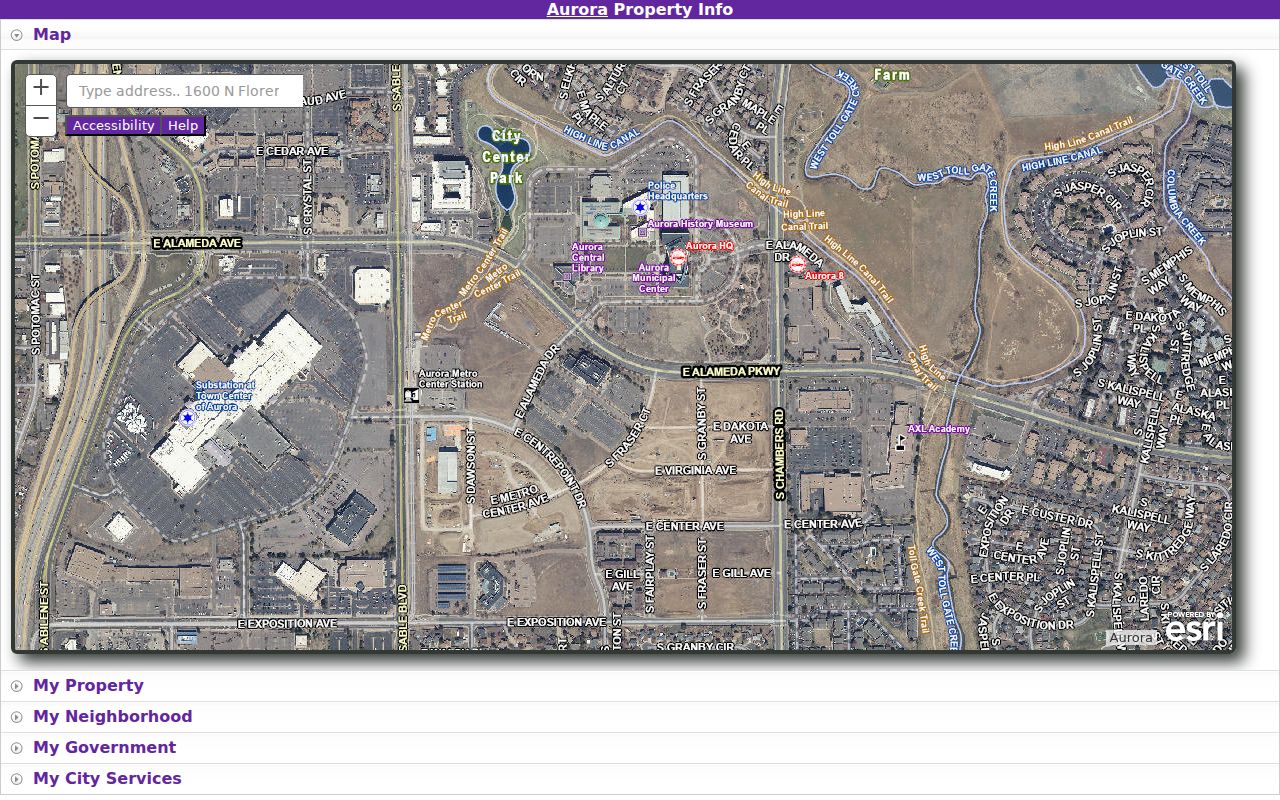
One Aurora address can open many doors. The map's categories pull county, parcel, permit, HOA, neighborhood, ward, school, and document checks into a single view. The deed and tax records behind them still live with the county custodian, so the map routes you there rather than replacing the office.
Aurora Resident Voter Matches and Public Fields
Colorado's official voter lookup matches one person at a time. It is not a bulk resident roll. Four inputs are required: first name, last name, date of birth, and residential ZIP. A match can point toward registration status. It can also show residential or mailing address details, precinct or district, party, county clerk, and ballot status. Enter the name exactly as registered. Check the residential ZIP too. A no-match can mean a name variant. It can also mean a different county, a protected status, or a combination that simply does not line up. It never proves a person is absent from Aurora.
The Secretary of State splits voter fields into public and confidential sets. Public fields include full name and residential address. They also cover party affiliation and its date, phone if supplied, gender identity if supplied, birth year, and prior-election participation. Confidential fields include Social Security number and driver-license number. They also cover full birth date, signature, email, and protected-voter information. Voter history shows participation only, never ballot choice. Voters facing criminal harassment or bodily harm can use a county confidentiality process. Address Confidentiality Program participants are excluded from ordinary voter-information release.
Larger reports take a separate request. The SOS data-request form lists an EX-003 weekly statewide registered-voter list. It also lists EX-002 voter history and other report codes. Fees published on the form include a $1,000 subscription for the 2025-26 cycle. They also include $50 per data disc for several listed reports, with mail, pickup, signature, and payment fields. Request the smallest scope you need through the SOS form or the right county clerk. Do not rebuild a street or block roster by scraping a person-match form.
| Search field | How the field is used |
|---|---|
| First Name | Given name used for the registration match. |
| Last Name | Family name used for the registration match. |
| Date of Birth | Match field; the full birth date is not a public voter-file field. |
| Residential ZIP | Geographic match field for the registered residence. |
The Colorado voter lookup source used for this voter-match search is shown below.
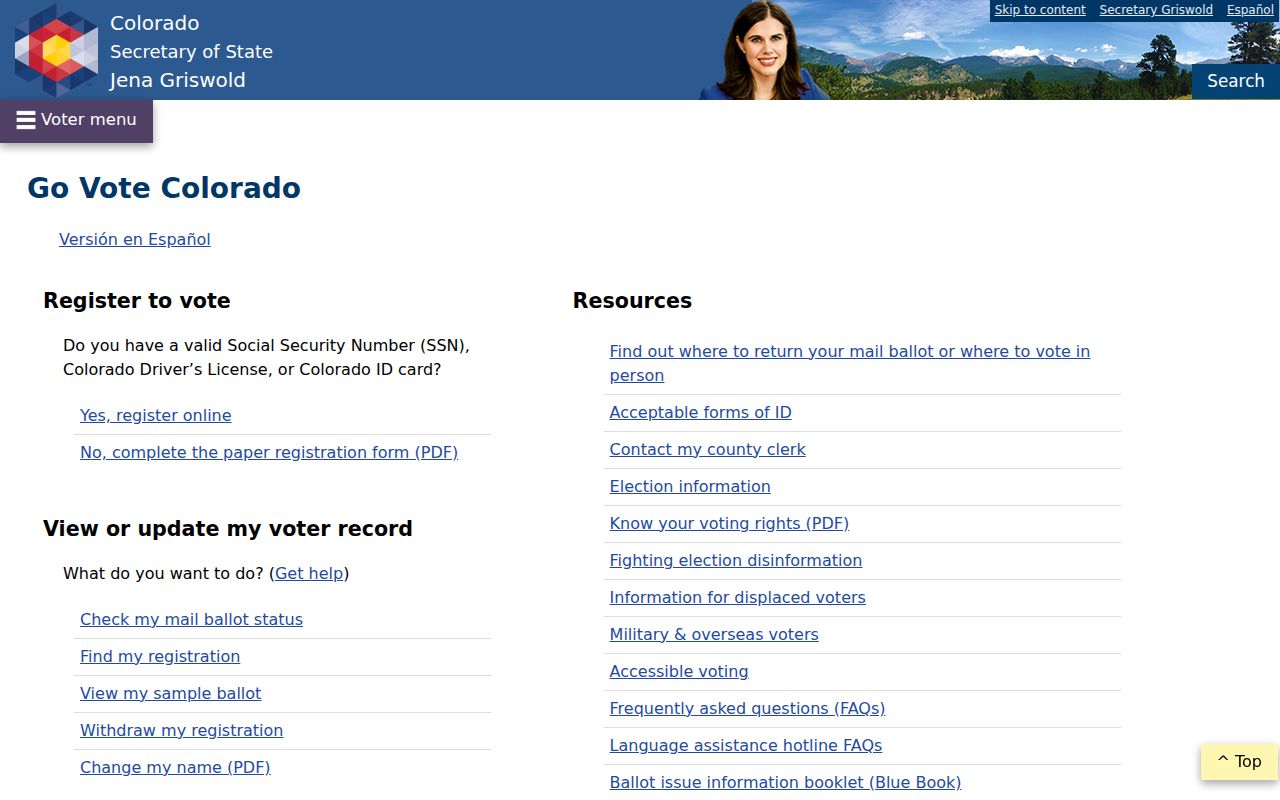
Those four required fields work well as an identity check. Still, keep the public and confidential split in view before drawing any conclusion from a match.
Current Aurora Residents Directory Sources
Current resident records work best as separate coverage layers. An owner record is not a resident record. A registration match is not proof anyone was present on a given day. The table pairs each question with its keeper and access path, so any resident-record result can be checked at its source.
| Source layer | Question answered | Keeper and route | Access limit |
|---|---|---|---|
| Assessor parcel card | Who is listed as owner, and what situs or mailing line follows the parcel? | Arapahoe, Adams, or Douglas assessor | Mailing line is not proof of residence; county search differs |
| Recorder index | Which grantors, grantees, liens, plats, or releases touch the legal description? | Correct county Clerk and Recorder | Images, old books, and certified copies may need office or fee service |
| Voter match | Does a name, DOB, and ZIP combination match a registration? | Colorado SOS and county clerk | Protected and confidential voters are withheld; web form is not a bulk file |
| City permits and public documents | Which permit, project, plat, or business field is tied to an address? | Aurora map, city search, or CORA custodian | Applicant or contractor is not necessarily owner or resident |
| Historical directories and notices | Was a subscriber, householder, business, or institution listed at an address? | Library, museum, DPL, LOC, CHNC, or archive | Year, geography, OCR, and subscriber coverage vary |
The assessor and recorder hold the strongest current property trail. The voter tool is a person-match clue. City records add a project or address timeline. The library and archive layer can explain a former resident, a family connection, or a street label that no longer fits. A question about one person needs its own verification pass, while the Aurora street directory keeps the address chain in parcel order.
The Arapahoe parcel card source accepts AIN, PIN, and address modes. After a result it can show an owner, mailing address, situs address, legal description, parcel identifiers, value and tax context, and map links. Address mode is not the preferred assessed-property route. Use the AIN or PIN whenever possible.
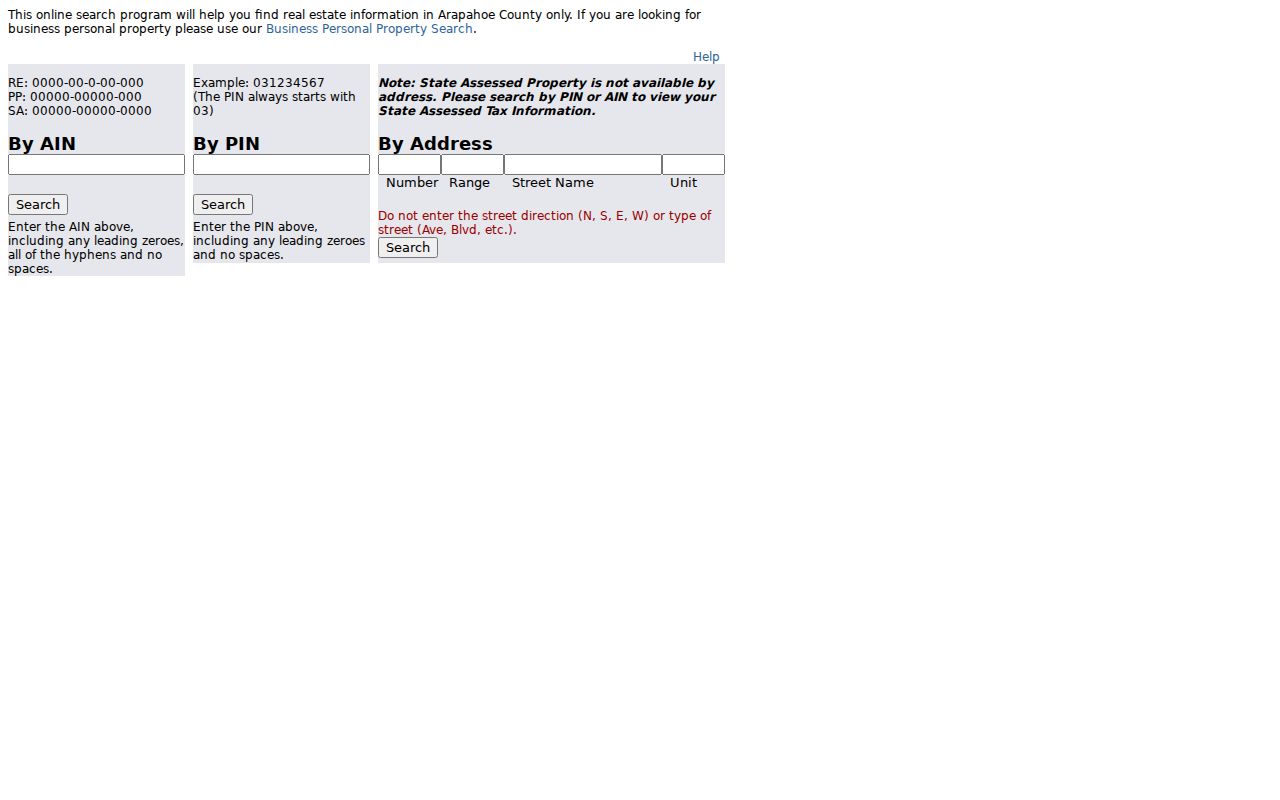
The county parcel layer hands you the key identifier. With it, an address clue crosses into a legal-description and recorder search.
Arapahoe, Adams, and Douglas Deed Trails
The correct recorder depends on the parcel, not the word Aurora alone. Arapahoe's Official Records Search offers Quick Search and Advanced Search for Real Property. Visible options include grantor or grantee, subdivision, document type, document number, and recorded-date range. Preset ranges run from the last 24 hours through one year, plus a custom range. Index-only and index-plus-full-text OCR modes are both available. The portal does not state a historical starting year for its records.
Every chain starts with the parcel legal description or AIN. Search the present owner as grantee and open the purchase deed. Identify the seller as grantor. Carry the lot, block, subdivision, or other legal-description language forward, then search that seller as the next grantee. Repeat the cycle while checking reception or instrument numbers, recording dates, deed type, liens, releases, easements, deeds of trust, quitclaims, and estate or personal-representative instruments. A name-only result is a lead, not a chain.
Adams County's LandmarkWeb supports Name, Document, Book/Page, Consideration, Record Date Range, Reception Number, and Legal Search. Non-watermarked online copies are available without a login, and certified copies come through the office. Douglas County's LandmarkWeb uses similar modes plus Instrument Number, indexes names Last, First, and warns that street addresses are not indexed. Douglas recommends one-to-five-year date ranges and identifies research stations holding some 1800s material. Adams and Douglas assessor and recorder portals each govern their respective Aurora parcels. The Arapahoe official-records index sits at the link shown here.
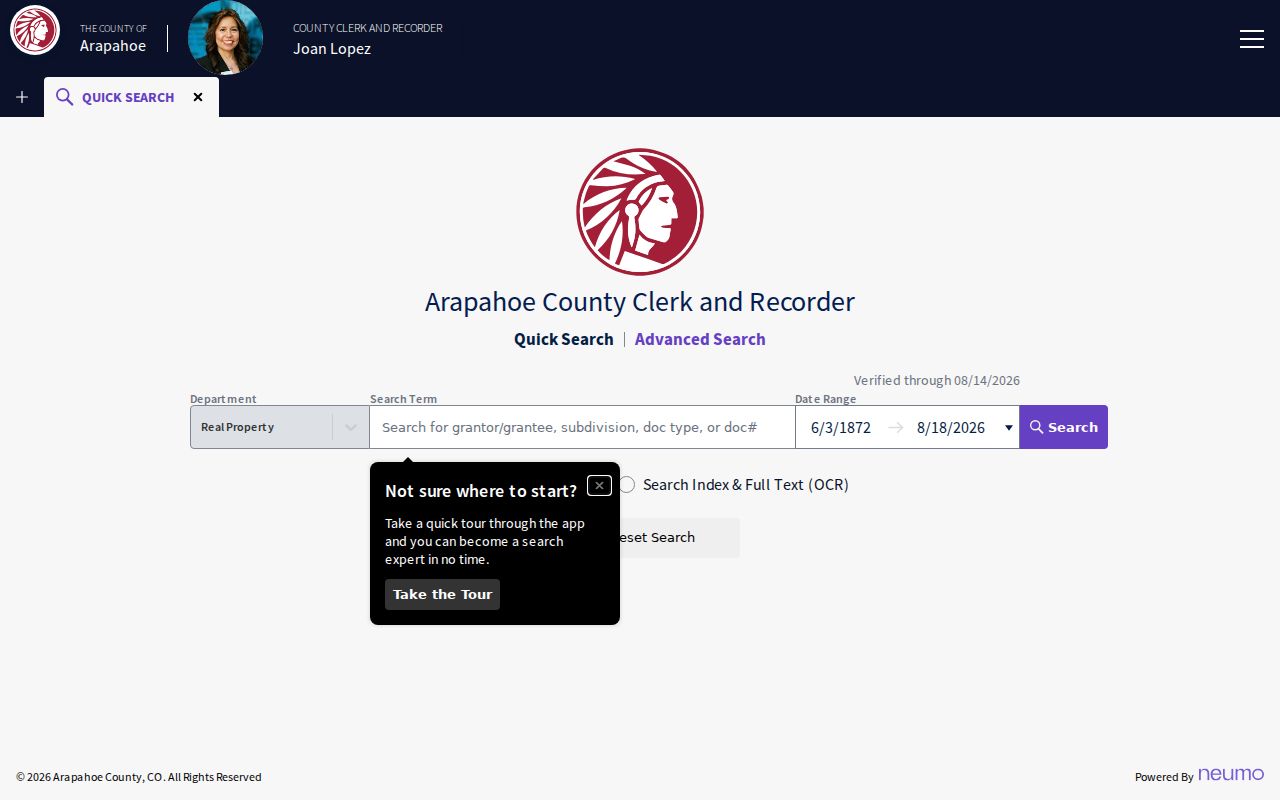
Exact live result fields stay tied to the current query. The portal publishes no stable named deed row. Read reception number, party, date, legal description, and image details from the result itself rather than guessing.
Aurora Resident Court Dockets Need Context
Colorado courts put hearings online, but a docket is only a schedule. The Colorado Judicial docket search lets you filter by Judicial District, County, Courthouse, Court Type, Division, Date Range, a specific date, case year, Case Class, and Case Sequence. Party filters cover Individual or Business, First and Last Name, and Business Name. Attorney fields include name and Bar Number. One filter beyond date is required before results load. Each row shows date, time, duration, the displayed name, case number, hearing type, location, appearance type, and courtroom. Export and print controls sit alongside. An empty result does not clear anyone. The case may sit in another county, an older case year, or a different case class. Run the county that holds the Aurora parcel, widen the date range, and try spelling variants. Then ask the clerk for the register of actions or the filed record. A sampled Arapahoe row read Arapahoe County - Aurora. Others read Arapahoe County alone. So the courthouse label proves nothing about where a party lives. Arapahoe record requests go through a form or web route. Its fields cover requester, case, county, party, record type, certification, and delivery. The form quotes a 3 to 5 business-day response. It lists copy, search, research, and certification fees under CJD 06-01.
Aurora Municipal Court is a separate venue for municipal violations. Its public information page gives the court route, detention details, and phone contacts. Adams County courts sit in the 17th Judicial District. Arapahoe sits in the 18th, and Douglas in the 23rd. Pin down the right county and venue before a docket becomes part of an Aurora records search. The official docket screen shows every filter and result column described here.
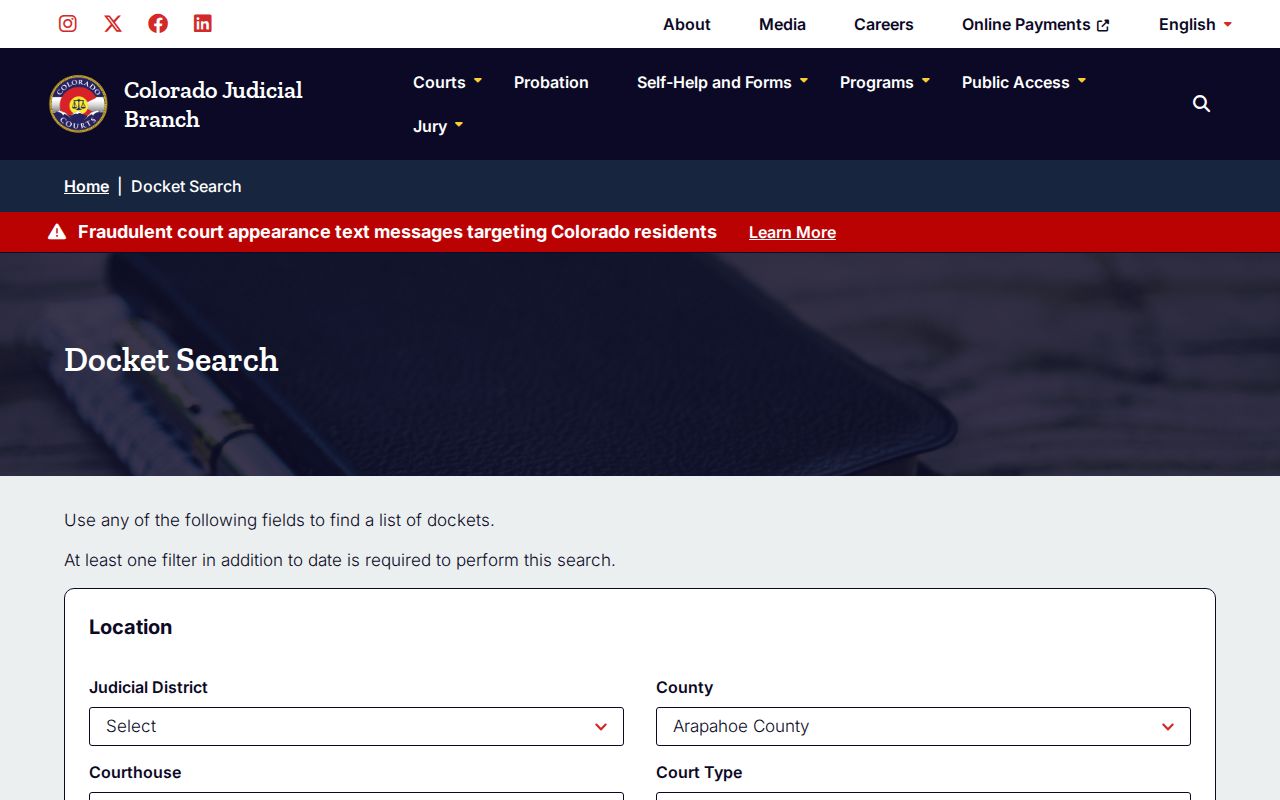
Hang onto the case number, year, court, and case class with any name match. Get the clerk-held record before drawing a conclusion. The Aurora municipal court and detention route appears separately in the next source image.
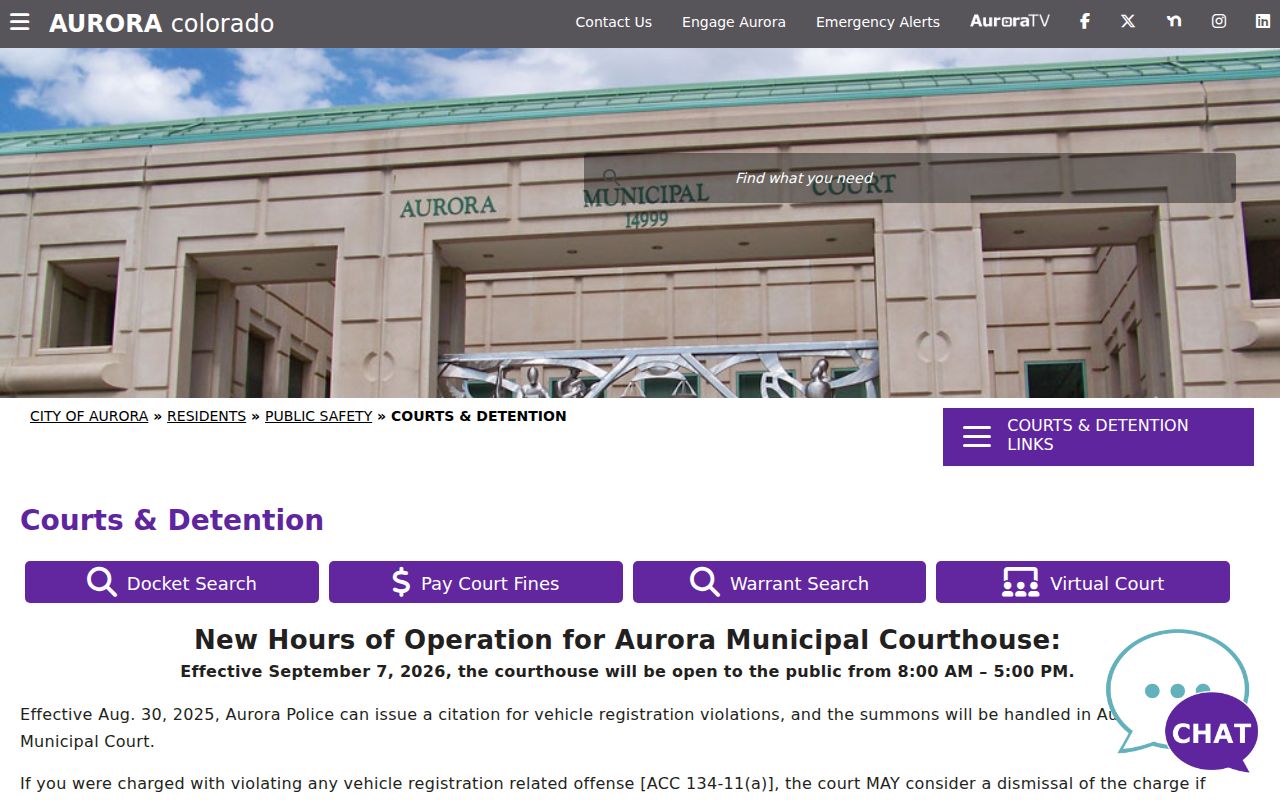
The municipal route does not replace county, state, or federal court searches. A custody or warrant result is only a limited snapshot.
Aurora Vital Records Have Narrow Access
Vital records are not a public name directory. Birth, death, marriage, civil-union, divorce, and adoption files stay closed. The controlling law is Colorado's vital-statistics statute, C.R.S. §25-2-117. The statute allows a certified copy to only one kind of applicant. That person must show a direct and tangible interest under the program rules. No simple rule opens every record after a set number of years. Eligibility, identity, relationship, and record class decide the route.
The CDPHE order route handles several documents. It covers standard and heirloom birth certificates. It also handles standard death certificates, marriage or civil-union verification, and divorce verification. Applications ask for a lot. Expect applicant contact details plus the subject's name and event details. They also want a relationship or eligibility category, photo ID, and proof of direct and tangible interest. Delivery details and payment complete the list. Fees are nonrefundable. Normal online processing runs about 30 business days. In-person service is appointment-only with no walk-ins. Eligible birth or death copies may come from local county offices. The county Clerk and Recorder handles marriage or civil-union licensing. District court holds divorce files.
Colorado State Archives is a different layer entirely. Its birth-record guide says holdings are generally at least 100 years old. Post-1908 records usually stay with CDPHE. Adams and Arapahoe guides hold older county material. Examples include early birth and death registers, cemetery plot certificates, and coroner inquests. Send archives requests to the Denver location, framed as historical record requests rather than current-person searches. Adoption files run through the Voluntary Adoption Registry and confidential-intermediary routes, never a public parent-child index. The official vital-record order route is the CDPHE page linked above.
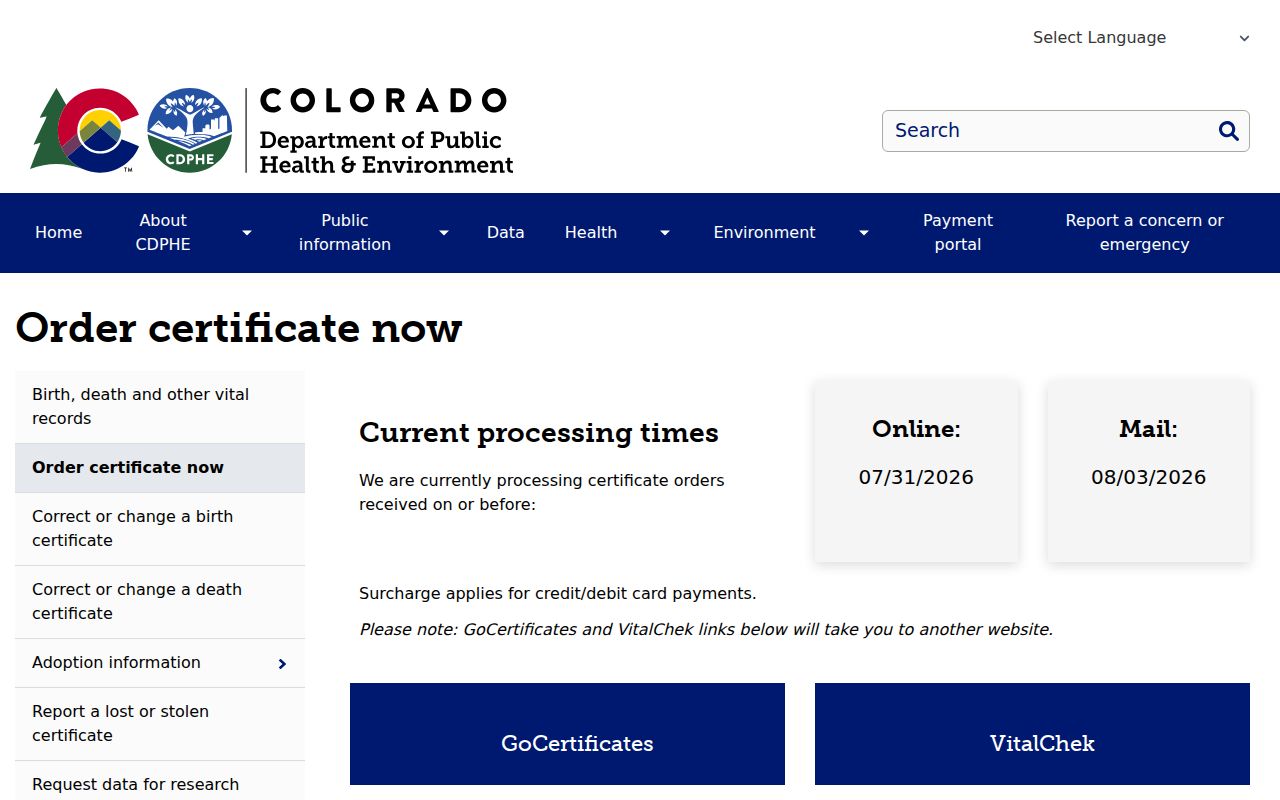
An obituary, directory entry, or court docket can hint that an event occurred. It still cannot substitute for an eligible certified record.
Aurora Records Requests Through CORA
Some Aurora records never appear in a portal. Those go through the Aurora public-records page or the city's CORA NextRequest portal. The Colorado Open Records Act, C.R.S. §24-72-102 et seq., governs the process. Public-safety material falls under the Colorado Criminal Justice Records Act, C.R.S. §24-72-301 et seq., instead. Aurora's policy asks for a written or NextRequest request. A verbal ask or a social-media message will not start the clock. Name the department or custodian and the record type. Include an address, parcel, case, or permit number. Add the date range and your preferred electronic format.
The normal response window is three working days. An extensive request can earn a seven-working-day extension. Electronic release is the city's preference. Fees are spelled out in the inspected policy. The schedule lists $0.25 per physical page and $41 per hour after the first hour for research, retrieval, or review. A 50 percent deposit is possible once a request is expected to pass $100. Redaction can touch personally identifying information, confidential or privileged material, and other exemptions. The city will not build a new record just to answer a question.
The city request form covers a lot of ground. It collects requester and account information, department, subject, and a detailed record description. It also gathers address or parcel, case or permit number, date boundaries, and preferred format. Attachments, notification fields, status messages, and released-document downloads are included too. Exact labels and required markers shift on the form. Police and 911 records need a separate custodian through the CCJRA route. County deeds, assessor cards, court files, and vital records stay with their own offices. That rule holds even when an Aurora address is involved. The Aurora public-records routing source shows the city's official description of the path.
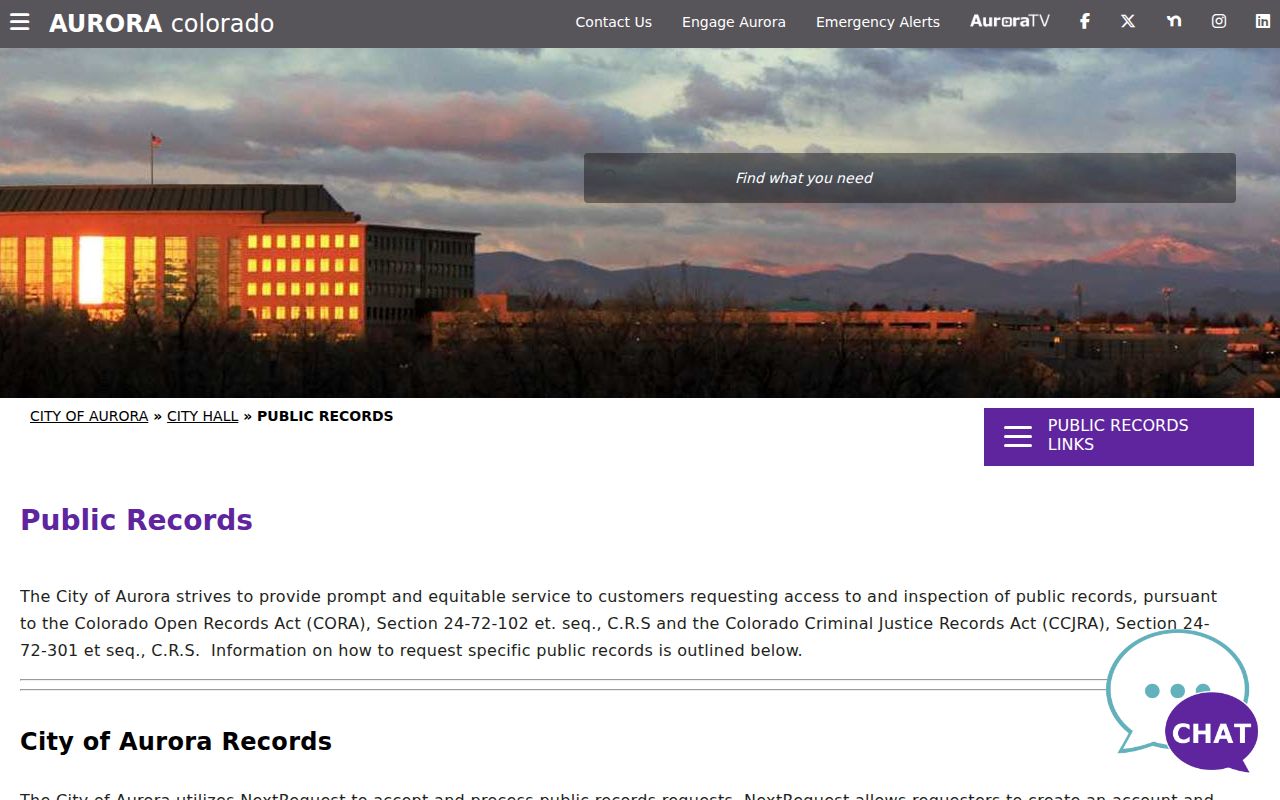
A narrow request works best. Give the custodian one address and a tight date range, and the record key becomes usable while accidental disclosure becomes far less likely. NextRequest supplies the account and the written submission route.
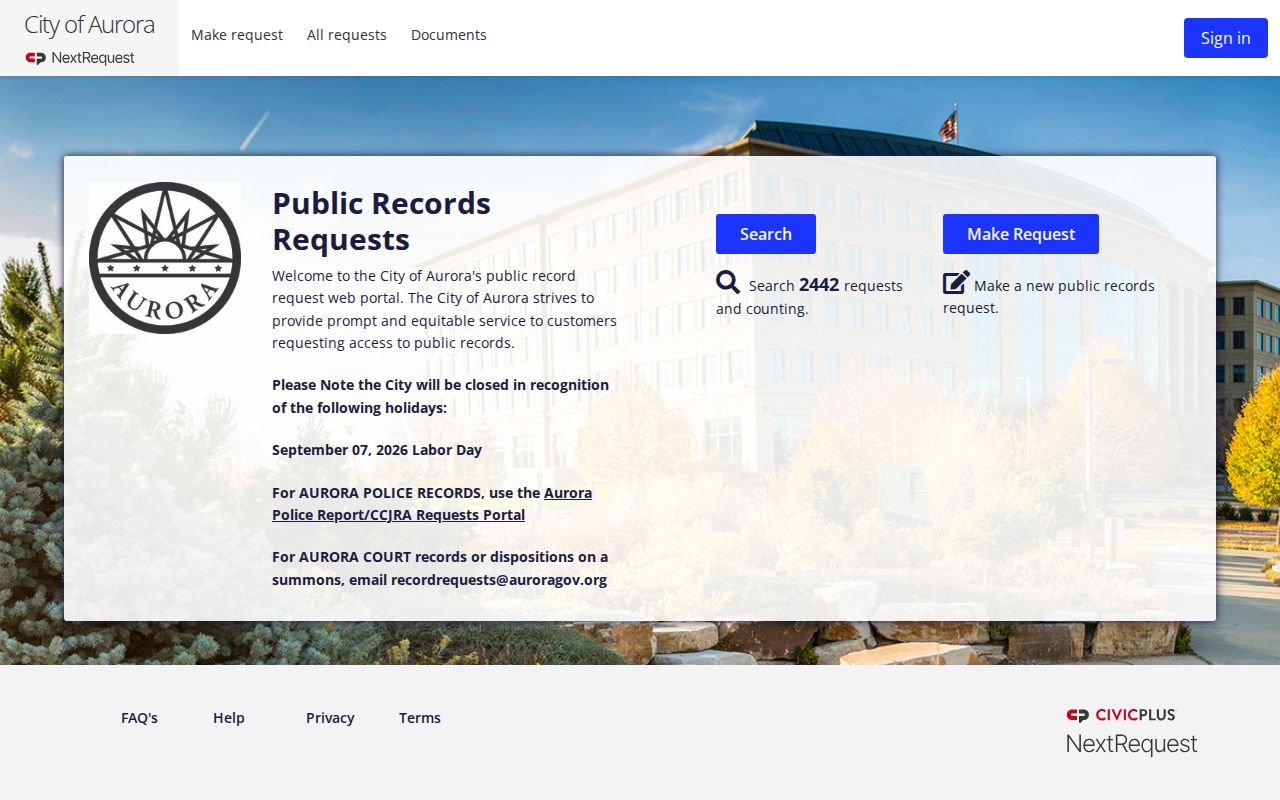
Read every released file before treating it as resident evidence. Check the redactions, the source office, the date, and the record type first.
Aurora Records Compared by Purpose
Aurora has two broad kinds of lookup tools. Official records offices keep the originals close to the event itself. A parcel entry at the assessor, a deed at the recorder, or a voter roll line from the records office carries real documentary weight. Each of those carries real documentary weight. The tradeoff is narrowness. An official index may cover one record type, lag behind life changes, or sit behind access rules.
| Route | Best use | What it can establish | What still needs checking |
|---|---|---|---|
| County assessor or recorder | Parcel and ownership history | Tax-roll owner, legal description, parties, dates, recorded instruments | Residence, household members, missing older images, county boundary |
| Colorado voter lookup | One registration match | Name, DOB, ZIP combination and public registration fields | Protected status, physical presence, full voter file, ballot choice |
| Library, museum, or archive | Historical people and address research | Listed subscriber, household, notice, image, or institutional context | Publication geography, OCR, unlisted people, current status |
| Compiled search service | Unverified lead generation | Possible public-record fragments and name variants | Origin, freshness, identity, corrections, and lawful use |
When an official source comes back silent, write down the exact search mode, the date, the county, and the access gap. A no-result statement is only as strong as its route.
Key Aurora Directory Terms
Write down the exact search mode, date, and access route whenever an official Aurora source comes back empty. A no-result claim is only as strong as the path behind it.
- Roll
- A recurring list kept for a purpose, such as the assessor's tax roll or a voter registration report. A roll has inclusion rules and does not list everyone in a city.
- Index
- A finding aid that points to a record or image. An index row is not always the full instrument, certified copy, or unredacted file.
- Parcel
- A legally described piece of land identified by an AIN, PIN, lot, block, subdivision, or other stable land key.
- Criss-cross directory
- An address-order or householder-style directory that can move from a street address to a listed occupant or owner for a covered year and geography.
- Situs address
- The physical location of a parcel or structure. It can differ from the assessor's tax mailing address or the USPS city and ZIP last line.
Keeping these definitions visible stops an owner name from turning into an unsupported resident claim. It also anchors a historical listing to its publication year.
Historical Aurora Residents Directory Collections
The Library of Congress offers the best fully digitized starting point. Its Aurora telephone directory runs from Winter 1936/37 through May 1947. White pages and yellow pages are both there, with text, images, and PDF access. An entry may list a subscriber or business name. It may also include a telephone number, a street address, and a classification. One OCR sample reads “Allen Frank R | r | 10355 E 23d av. | Aurora-209.” That line shows why the image matters. Columns and abbreviations often get mangled in plain text, so the scanned page is the safer read.
Older titles survive mainly as citations. Survey bibliographies from the Aurora History Museum point to several volumes. These include a 1930 Annual Directory, a 1939 Aurora Telephone or Mountain Bell volume, and the 1941 XL Directory of Aurora Section B. Also cited are a 1948 Complete Directory of Aurora and a 1952 Aurora Directory. Aurora citations also appear for 1953, 1955, 1957, 1959, and 1962. A 1972-73 Denver Suburban Directory appears alongside them. Publishers behind these volumes include XL Directory Service, Powell Advertising Sales Agency, Loveland references, and R.L. Polk. A citation proves only that a survey used a given year and title. It does not promise a free scan exists anywhere. The year-by-year shelf list and a method for reading entries sit on the Aurora city directory page.
The Aurora library gateway opens onto the Colorado Historic Newspapers Collection. That archive holds more than 750,000 pages from 199 titles dated 1859-1923, plus genealogy, history, and newspaper databases. Denver Public Library adds Colorado obituary scrapbooks covering 1934-1963 and regional directory indexes. One caution applies to any Denver volume. Check its municipality and suburban boundary before treating it as an Aurora city directory. Suburban sprawl blurred those lines for decades. The Colorado Bureau of Investigation registry source rounds out the final source image. It serves as a separate, bounded lookup that can sit beside historical research when the question calls for it.
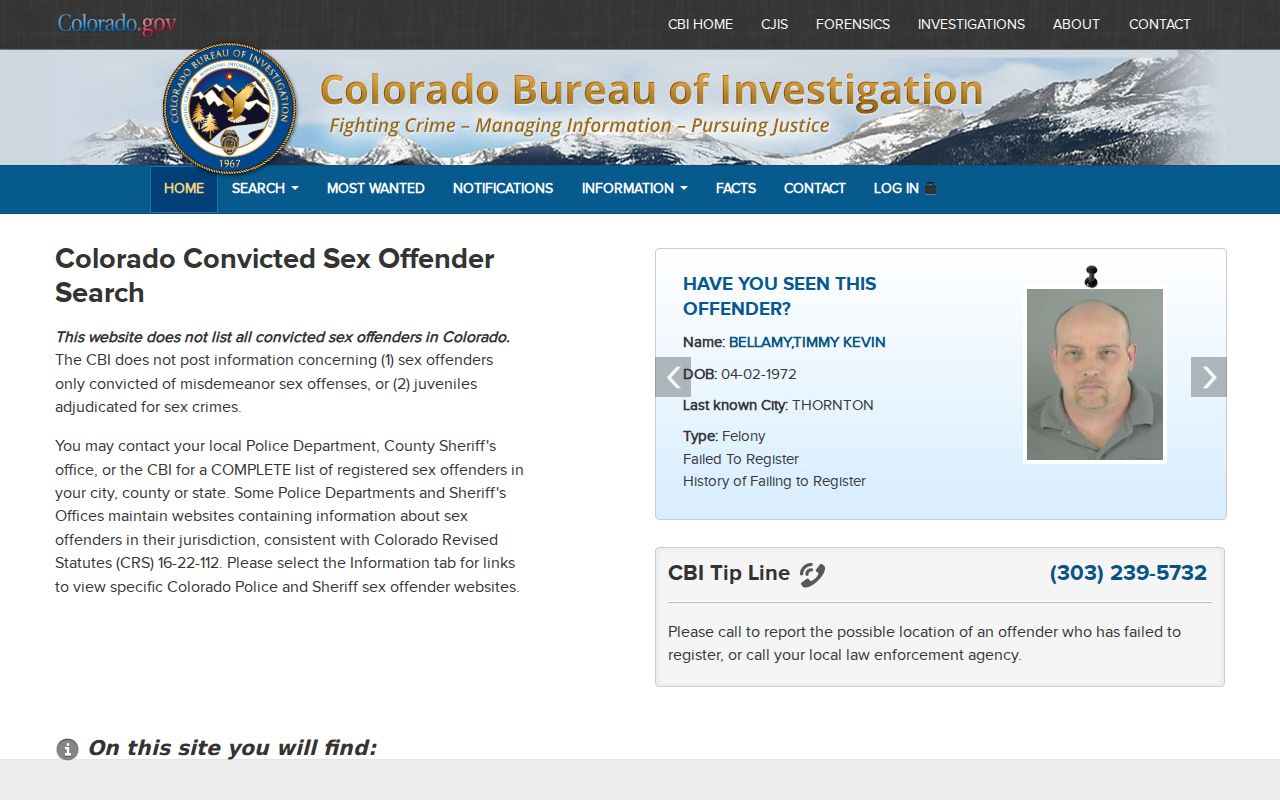
The Colorado Bureau of Investigation registry covers qualifying records only. It updates hourly and stops short of a complete criminal history. Treat it as a narrow official-record check, not as proof that any historical directory or current resident list is complete.
Aurora's Archive Trail Tells a Story
Aurora's paper trail is scattered across many keepers, and that shapes every resident lookup. The first public library opened in Sarah Wood's home. It sat at 1516 Dallas Street. The date was February 10, 1929. Preservation came later. The city's library history dates an organized city-record preservation program to 1977. The library assumed responsibility for archives in 1985. One address can therefore require many keepers. You may need the city map, a county recorder, a library database, a museum finding aid, and the state archive. No single continuous resident roll exists.
Era matters too. Fletcher became Aurora in 1907, after early trolley and rail growth. Each era left a different kind of clue. The 1926 Sanborn map shows building footprints, while the 1936/37-1947 telephone run lists households street by street. The Hoffman Heights bibliography, later suburban directories, census releases, GIS and ArcGIS layers, dockets, voter verification, and NextRequest each preserve another sliver. The 1950 census is open under the 72-year rule. The 1960 census remains sealed. Pair a directory year with the nearest open census. Then test the address against a deed, a newspaper item, an obituary, or a museum record.
For missing years, use precise language. Say not digitized, not held, dynamic, or simply not in the official material. A blank year is not proof that no record existed. The museum offers supervised appointments, finding aids, research requests, and a reproduction service. A library, the Aurora Genealogical Society, a FamilySearch Center, or the State Archives can point toward a different repository that fills the gap.
Aurora Records Stop at a Privacy Boundary
No residents directory shows everyone at an address. Privacy law draws hard lines. Private utility and delivery lists, DMV address information, complete unit-level household lists, and protected voter information never become general public layers. Vital records stay confidential. Juvenile, sealed, suppressed, expunged, adoption, and protected domestic material may be withheld or redacted. Colorado's Address Confidentiality Program gives eligible participants a substitute address with confidential mail forwarding, and protected voters can be excluded from ordinary voter release.
Lawful personal use. Public records support genealogy, civic research, property history, reconnection, and verification of a specific source. Do not use an address or person record to stalk, harass, threaten, monitor, or harm anyone. If a search touches a safety concern, stop and use the appropriate official support or law-enforcement channel.
The Colorado Privacy Act grants access, correction, deletion, portability, and opt-out rights for covered personal-data processing. Government records sit outside it. The Attorney General describes public records held by government as excluded from the Act's personal-data definition. A privacy request to a compiled provider erases nothing. A county deed or court index stays intact. Corrections and confidentiality questions belong with the originating assessor, recorder, clerk, court, election office, or vital-record custodian.
That boundary is part of accuracy. A careful result in an Aurora residents directory names its source, the coverage, the date it reflects, and what it cannot show.
Aurora Research Stops Before Harm
Scammers follow the records trail too. Aurora's municipal court posted a January 6, 2025 scam alert about impersonators posing as probation or court officers. They threatened a warrant or arrest. They demanded gift cards or wire payments. Court staff will not call to collect a fine without written documentation, nor request a street, store, or jail cash payment. Go to the official agency domain yourself. Dial the published number, never a link inside an unexpected message.
Apply the same care to a deed-copy letter, a court text, or an unclaimed-property message. Ask for specifics. Record type, parcel, case number, reception number, fee, and official payment route all belong in the answer. Keep a request log. Verify any payment demand with the custodian first. An Aurora residents directory is a research aid, never permission to confront, monitor, or expose a person.
An unavailable source still has an honest endpoint. The route is an access channel: a county counter, an assessor or recorder phone, a clerk email, a mail request, a court form, library microfilm, a museum appointment, a State Archives request, or a narrow CORA/CCJRA submission. The record may remain outside the web, but the route to the custodian can still be documented.