
Aurora Resident Records at a Glance
A useful Aurora resident lookup is a set of linked clues, not one master file. The county assessor starts with an owner, parcel, mailing line, and legal description. The recorder follows recorded instruments. Colorado's voter tool tests a name, date of birth, and residential ZIP against a registration match. Courts show public docket activity, while vital records, adoption files, juvenile matters, and protected records use narrower rules.
| Record | What It Confirms | Where | Access |
|---|---|---|---|
| Assessor and parcel | Current owner, mailing line, situs, parcel and legal description | Arapahoe parcel search; Adams and Douglas portals | Free search; county copy rules apply |
| Recorder and deed index | Grantor, grantee, recording date, instrument and legal-description trail | Arapahoe official records; Adams or Douglas recorder | Index access; images and certified copies vary |
| Voter registration | Name, date-of-birth and residential-ZIP registration match | Colorado voter lookup | Match tool; confidential fields are withheld |
| Court docket or register | Public hearing, case number, party and location clues | Colorado Judicial docket search; Aurora Municipal Court | Free docket; copies and research can cost money |
| Vital records | Birth, death, marriage, civil-union or divorce route | CDPHE Vital Records; county offices; Archives | Eligibility and direct tangible interest required for many copies |
| Business or license filing | Entity, agent, license type, status or public affiliation clue | Colorado SOS and DORA verification | Public filing or license detail, not identity proof |
| Directory, obituary or archive | Historical address, subscriber, family, institution or estate clue | Aurora Library, History Museum, DPL, LOC, Archives | Year, geography and scan access vary |
Choose the first source by the fact already in hand. A street address belongs with the city property map and county parcel route. A name with a birth date belongs with the voter match or court filters. A family-history question belongs with directories, newspapers, obituaries, probate, and eligible vital records. A business connection belongs with state filings, DORA, or city permit fields. These records can corroborate one another, but no row should be promoted from a clue to a conclusion without a second anchor.
Aurora Resident Name to Current Address
A name-to-address workflow must separate a current official clue from an assumption about where a person lives. The Colorado voter lookup uses first name, last name, date of birth, and residential ZIP. If it matches, note the county, precinct, and route needed for the question. If it does not, try a legal name variant and confirm the ZIP. The public fields described by the Secretary of State do not include a full birth date, signature, email, or protected-voter information.
- Start with a known name variant, a date range, and the county most likely to hold the record. Aurora addresses can route to Adams, Arapahoe, or Douglas.
- Run the Colorado voter match with first name, last name, date of birth, and residential ZIP. Treat a protected-voter omission as an intentional privacy result.
- Use the county assessor only when the person is tied to property. Arapahoe's principal modes are AIN, PIN, and address; a parcel result exposes owner, mailing, situs, and legal-description fields.
- Check county and municipal court dockets for the same county, name variant, and date range. A court filing may carry an old address, so keep the date beside it.
- Use recorder documents, SOS business filings, DORA details, or an Aurora permit as an affiliation clue. A mailing, registered-agent, license, or permit address is not proof of residence.
- Stop when the evidence is sufficient for the personal question. If a specific record is still needed, request that record from its custodian rather than asking an office to conduct an open-ended person search.
Property records deserve a special caution. A tax mailing address is where notices go. It can be outside Aurora, outside Colorado, a post-office box, or a trust, business, estate, or prior address. The physical situs, legal description, and owner field belong to different record questions.
Aurora Resident Matches Need a Second Anchor
Same-name errors are the central risk in a resident lookup. An assessor owner, court party, voter registrant, licensee, and directory subscriber can be different people who share a name. Compare middle initials, age or birth year, spouse or parent, county, street, subdivision, occupation category, and the date of each source. A county mismatch is a warning. It is not a reason to choose the closest result.
Search spelling in more than one form. Try last-name and first-name order, initials, married or maiden forms, suffixes, hyphenation, punctuation, trust or corporation wording, and the recorder's Last, First convention. Keep the original spelling in a research note. A short timeline helps: write the source date, address type, named party, and confidence beside each match. A 2026 voter match cannot prove a 1950 census address, and a 1952 directory row cannot prove a 1948 deed owner.
The Colorado Secretary of State voter data guidance describes the public and confidential split behind the statewide match. A registration result can be a useful human-use clue for reconnecting with a classmate or checking a family-history hypothesis, but a protected voter may be intentionally absent.
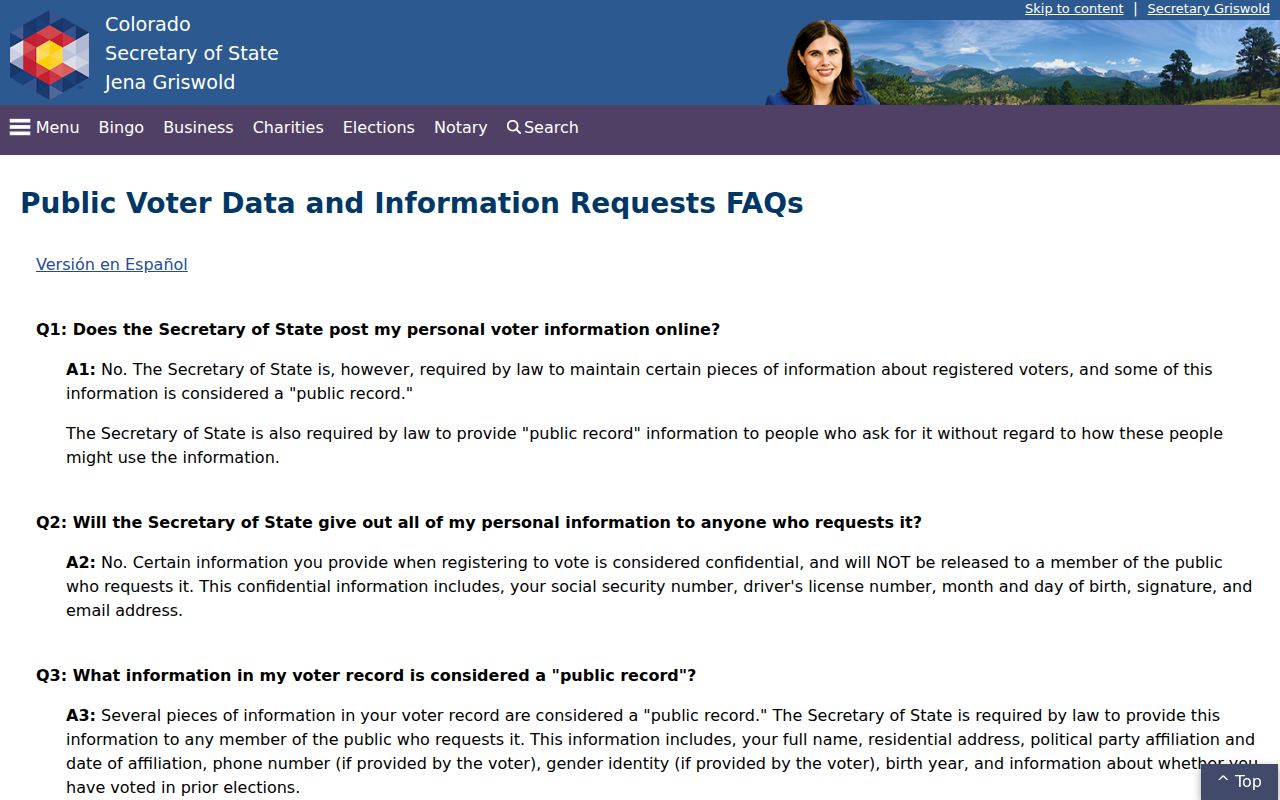
The voter screen is a verification step, not a complete public voter file. Use only the result needed for the lawful question, then corroborate it with a parcel, court, directory, or family record.
Aurora Resident Lookup Dockets
The Colorado Judicial docket portal is a schedule and party-search tool, not a single Aurora database. Its filters include judicial district, county, courthouse, court type, division, date range or a specified date, four-digit case year, case class, case sequence, individual or business party, first name, last name, business name, attorney name, and attorney bar number. At least one additional filter is required along with the date. Aurora Municipal Court is a separate municipal-violation route, while Adams, Arapahoe, and Douglas addresses use their respective county and district court paths.
The portal's exact search-field and result schema can be kept beside a name-match log:
| Field group | Exact fields or rule |
|---|---|
| Location | Judicial District, County, Courthouse, Court Type, Division |
| Date | Date Range or Specify A Date |
| Case number | Four-digit case year, Case Class, Case Sequence |
| Party | Individual or Business; First Name; Last Name; Business Name |
| Attorney | Attorney Name or Attorney Bar Number; Attorney Bar Number; Attorney First Name; Attorney Last Name |
| Validation | At least one additional filter is required in addition to date |
| Result row | Date, time, duration, name, case number, hearing type, location, appearance type, courtroom |
A docket field can narrow the search, but it cannot establish residence. The inspected Arapahoe view uses both “Arapahoe County - Aurora” and “Arapahoe County” as locations. Keep the court, county, year, and class with the result before requesting the register or a filed document.
The Arapahoe court records request route supplies webform and form/mail options. Requester fields include last name, first name, agency if applicable, mailing address, email, and phone. Case fields include case number, case type, year filed, county/location, date of birth, party name, and other identifying information. The form lists Register of Action, certified or exemplified copy, and other controls, with 3 to 5 business days stated for response.
The courthouse counter and clerk route remain important when an online result is incomplete. The Arapahoe court page lists Arapahoe Justice Center and Littleton Courthouse routes, 18records@judicial.state.co.us for record research, and a Monday through Friday public schedule. It also states that fees can include $0.25 per electronic page, $0.75 per paper or court page, a $5 non-party search including an ROA, and other certified, transcript, research, and postage charges. Recheck the current schedule before payment.
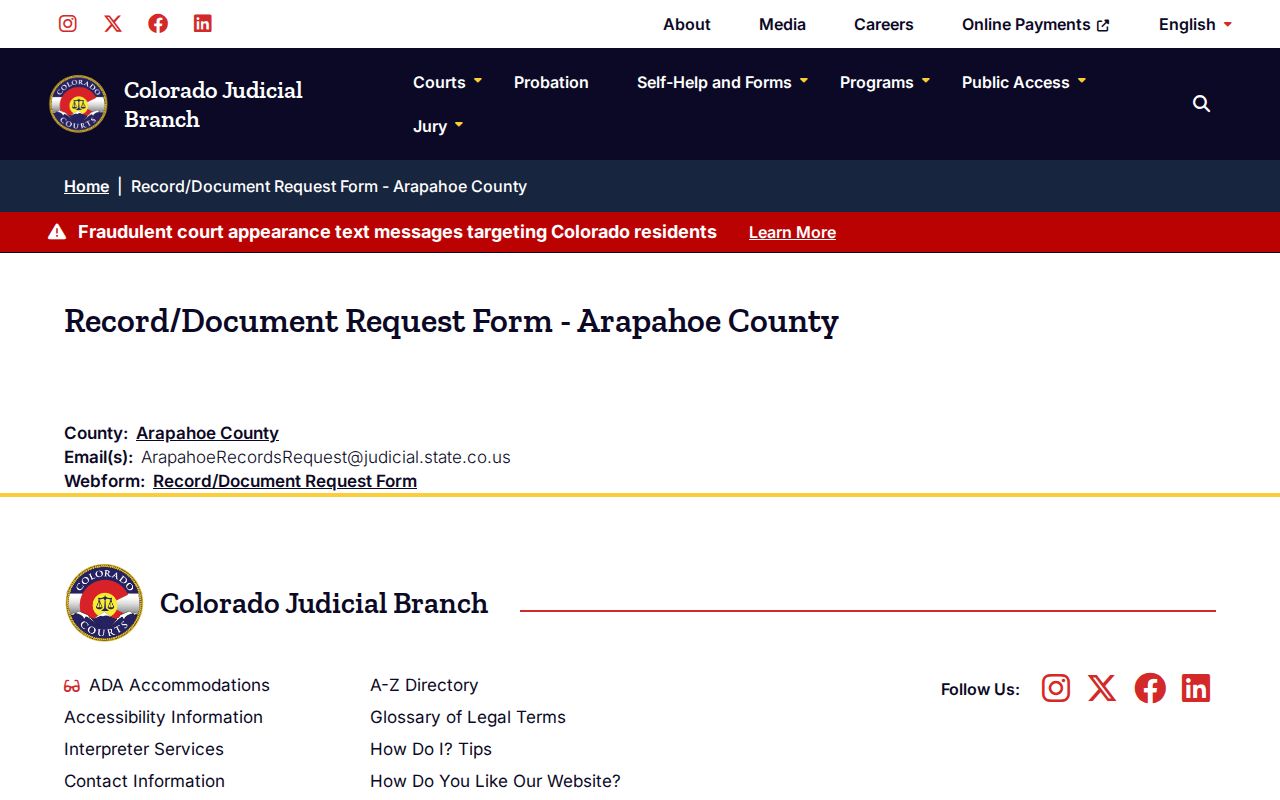
The request form is useful because it asks for a case identifier and record type rather than inviting a vague name search. Suppressed, juvenile, probate, and protected information can require identity documents or remain unavailable.
Aurora Resident Docket Rows and Case History
Read a result as a scheduled or indexed event. The official schema records the result date and time, duration, name, case number, hearing type, location, appearance type, and courtroom. The sample rows below are only official schema examples from inspected Colorado Judicial pages. They are not examples of an Aurora resident's identity, address, guilt, or complete case history.
- WILLIS, LANCE: 7/27/2026, 8:30 a.m., 1 hour, case 2009T203745, Appearance on Bond, location Arapahoe County - Aurora, blank appearance type, courtroom 401.
- LANGE-BLACKFORD, DERECK: 7/11/2026, 1 p.m., 1 hour, case 2026CR1664, Hearing on Advisement, location Arapahoe County, appearance type VIRTUAL, courtroom 202.
- SAWYER, RYAN: a comparable Arapahoe row in the inspected docket family, case 2026M3939, appearance type VIRTUAL, courtroom 204.
- Docket
- A public schedule or case-register view that identifies a court event and its basic fields.
- Index versus image
- An index points to a record by names, dates, or numbers; an image is the scanned or filed document and may have a separate access rule.
- Certified copy
- A custodian-issued copy with a certification that it matches the official record for an accepted purpose.
A no-result date search does not prove that a person has no case. Widen the date range, check the correct county and courthouse, test party-name variants, and ask the clerk for the register or file path.
Aurora Vital Records Have Tighter Access Rules
Vital records are not a public name directory. Under C.R.S. §25-2-117, Colorado vital statistics are confidential, and CDPHE may issue a certified copy to an applicant with a direct and tangible interest. The statute authorizes charges for reproduction, certification, search, delayed or corrected records, and verification. No simple all-records opening age was located in the statute. The Colorado State Archives 100-year policy is a separate archival rule.
| Record | Colorado route | Access and evidence | Channel |
|---|---|---|---|
| Birth or death | CDPHE or eligible county vital office | Identity and eligibility; no general current public name index located | Online order, phone 303-692-2000, email vital.records@state.co.us, mail or appointment |
| Marriage or civil union | County Clerk and Recorder; CDPHE verification route | Eligibility, ID, payment and record-specific rules | County web or counter, CDPHE order route, phone or mail |
| Divorce | Correct county district court; CDPHE verification | Court file and verification are separate; domestic details can be protected | Court portal, clerk counter, request form or mail |
| Historical birth or death | Colorado State Archives | Older county holdings; generally at least 100 years old | Archive guide, mail or phone 303-866-2358; library or archive research |
The Colorado order route asks for the applicant's identity and contact details, the subject's name and event details, relationship or eligibility, proof of direct and tangible interest when required, valid photo ID, delivery information, and payment. Fees are nonrefundable. The inspected page displayed about 30 business days for normal online processing and appointment-only in-person service, so current timing should be checked before an order.
The CDPHE Vital Records page is the source for the statewide access route shown with the Aurora resident lookup.
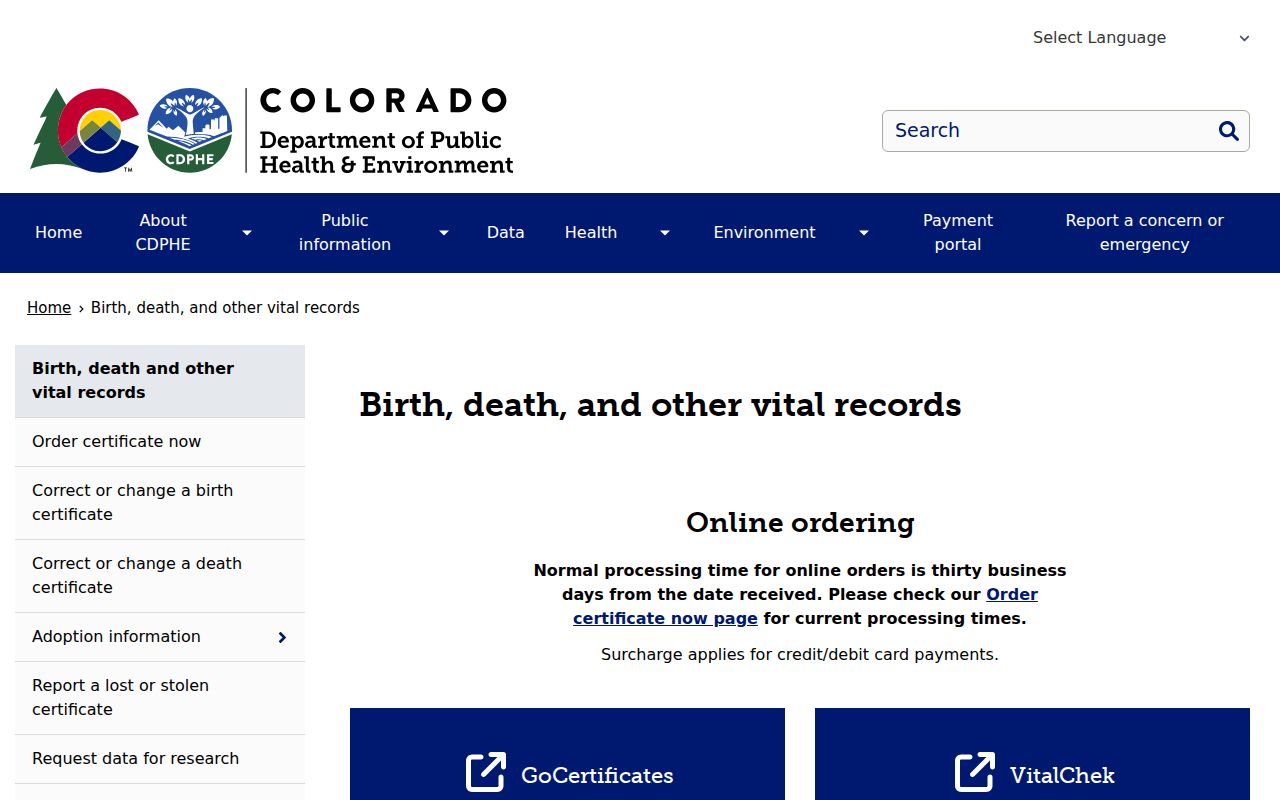
The image points to the state access route, not a searchable list of Aurora births or deaths. For an older clue, pair an obituary, cemetery record, probate file, or newspaper notice with the eligible official record rather than treating the notice as a certificate.
Aurora Adoption, Probate, and Classmate Paths
Different questions need different custodians. An heir search starts with probate in the correct county and then pairs the case register with deeds, obituaries, and eligible death records. A named heir is not automatically the person who occupied a parcel. A former classmate is better approached through yearbooks, Aurora Library databases, Aurora History Museum collections, newspaper notices, FamilySearch, or DPL. The inspected sources did not locate a consolidated Aurora school-yearbook index, so the year and school must be supplied to the library or archive.
For a birth-parent or adoptee connection, use the Colorado Voluntary Adoption Registry. Adult adoptees, siblings, birth parents, and former foster participants use a voluntary and confidential program. The listed route includes a notarized application, valid ID, nonrefundable fee, and proof of relationship, with C.R.S. §19-5-305 identified. A confidential intermediary is separate. This is not a public parent or child index.
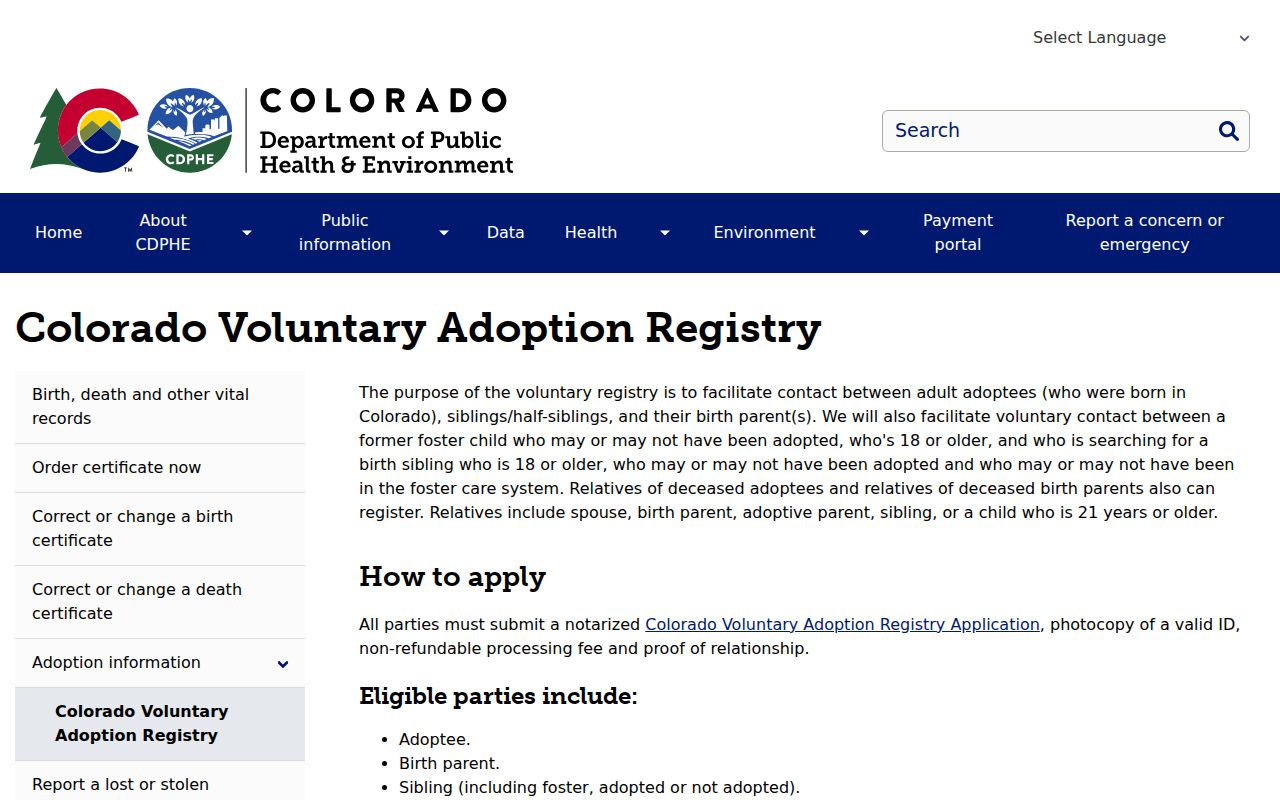
The registry image belongs to a protected family connection route. It should not be treated as evidence that a person can be located through a general resident lookup.
Historical residents can also surface through the Library of Congress Aurora telephone run, Aurora History Museum finding aids, Colorado Historic Newspapers Collection, DPL obituary scrapbooks, cemetery offices, the State Archives, and the Aurora Genealogical Society. The library and museum offer research, supervised appointments, reproduction, email, mail, and archive or counter channels, but the research file did not locate a citywide searchable Aurora interment index.
Aurora Business and License Clues
A person may appear in a record without that record being a residence record. Colorado Secretary of State business search can test an entity name, trade name, ID, document number, registered agent, filing date, or person field. The filing registry does not certify that a business is operating legally. DORA's license verification accepts profession, first or middle name, last name, license type, number, and status, with partial wildcard support. Details can show issue, effective, expiration, status, public address, actions, and public documents. Expired records from before 1990 may not have been converted.
Aurora's property map can add business-license fields, permit fields, HOA or neighborhood labels, and public-document links to an address. The city public-document search can show address, subdivision, or quarter-section records, including permits, plats, and other document metadata. These are affiliation clues. An applicant, contractor, registered agent, licensee, or permit contact is not necessarily the owner or resident.
The Colorado DORA verification portal is useful when a name is tied to a profession, while city records are useful when a name is tied to a parcel or project. Each result should be logged with its source date and address type.
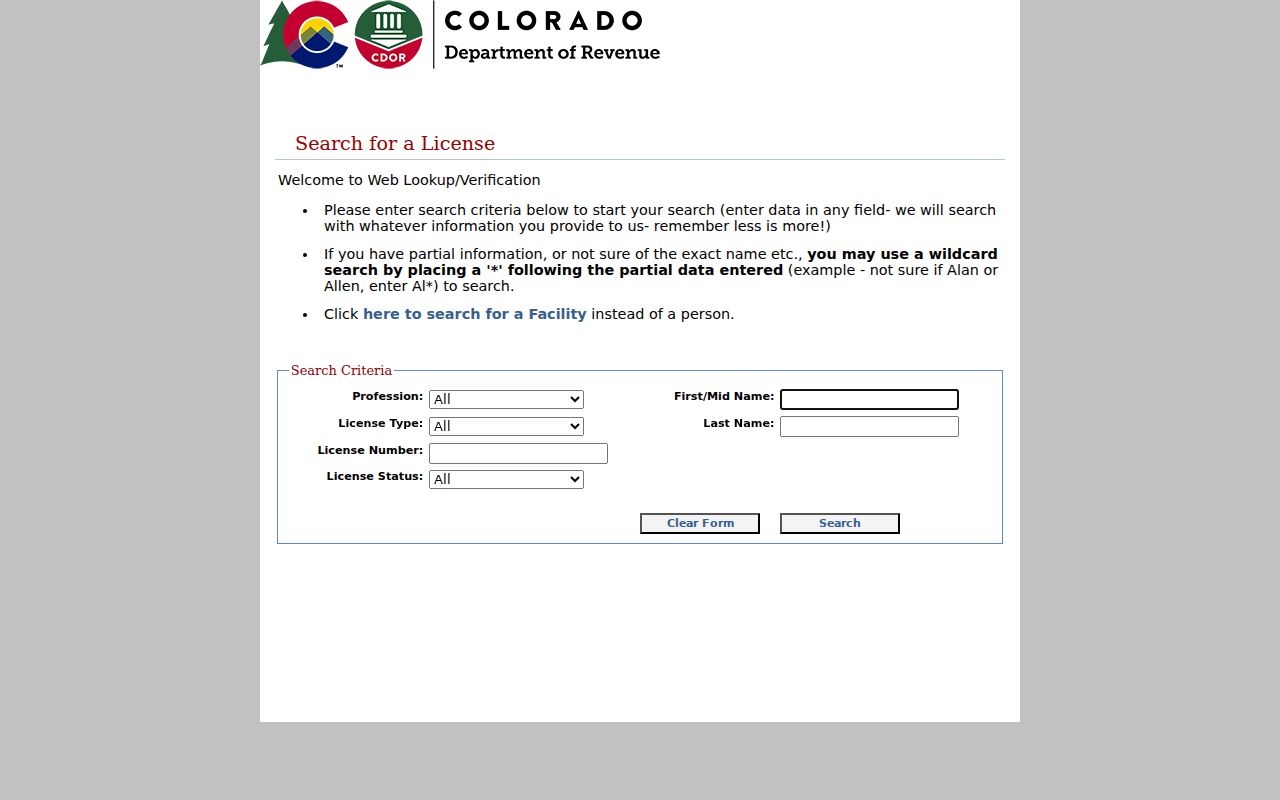
The license detail is a public professional record, not a current-resident confirmation. Use the county and state record that answers the actual question.
A Specific Aurora Records Request
When an online index stops, the fallback is a narrow request to the right custodian. Aurora routes ordinary city records through its public-records page and NextRequest. Requests may be submitted through NextRequest or in writing. The city policy gives a normal three-working-day response and permits a seven-working-day extension for extensive requests. Electronic release is preferred. After the first research, retrieval, and review hour, the policy lists $41 per hour; physical pages are $0.25, and a request over $100 can require a 50 percent deposit.
Include the record type, a person or parcel identifier, case or permit number, beginning and ending dates, department or custodian, preferred electronic format, and any supporting identifier. The city does not create a new record to answer a question. CORA, the Colorado Open Records Act, is cited at C.R.S. §24-72-102 et seq. Public-safety records use the Colorado Criminal Justice Records Act, or CCJRA, C.R.S. §24-72-301 et seq., with investigation, victim, juvenile, privacy, and other exemptions.
For county property or voter records, contact the custodian directly. Arapahoe lists assessor@arapahoegov.com and 303-795-4600 for assessor questions, and clerk@arapahoegov.com and 303-795-4200 for Clerk and Recorder questions. Mail, email, office counter, county research stations, and older books or microfilm fill the gap when a portal does not expose an image. A library or archive can locate a historical source, but it does not certify current ownership.
Aurora Resident Lookup Limits
Public records can be incomplete by design. A person may not be a property owner, voter, subscriber, licensee, party, or permit contact. A name may be outside the county, misspelled, sealed, suppressed, juvenile, adoption-related, or not digitized. A protected voter or Colorado Address Confidentiality Program participant may be excluded or shielded. The Colorado Privacy Act does not erase government public records, and the originating custodian controls correction, redaction, and confidentiality.
Use the Colorado Address Confidentiality Program information when a safety concern involves a substitute address or confidential mail forwarding. The Secretary of State's protected-voter process also limits ordinary release. If an assessor, recorder, election, court, or DORA record is wrong, ask that office for its correction procedure and provide the parcel, case, registration, or license identifier.
Privacy and lawful use. The Colorado Address Confidentiality Program, protected-voter status, and other privacy rules can shield an Aurora resident from ordinary release. An Aurora resident lookup is for personal, lawful research; using a record to stalk, harass, threaten, monitor, or intimidate another person can violate Colorado law.