
How Aurora Residents Are Found
A useful Aurora residents directory search begins with a record that can answer one narrow question. The county assessor can connect an address to a parcel and a tax-roll owner. The voter lookup can test a name, date of birth, and residential ZIP against a registration. A recorder index can show parties to a recorded instrument. A city permit or public-document row can place a business, project, or parcel in time. Older directories, newspapers, census schedules, and museum collections can place a person at an address in an earlier era. None of those sources alone is a complete list of everyone who lives in Aurora.
The strongest trail keeps the record type visible. An assessor mailing line is not proof of residence. A voter match is not a household roster. A docket row is not a case file, and an obituary is not a death certificate. Start broad enough to find the right county, then narrow by parcel, legal description, date, or source image. The same discipline helps with a current question and with a family-history search for a former Aurora address.
Use this five-step starter workflow when the clue is incomplete:
- Run the address through the Aurora property map and note the county, parcel ID, subdivision, lot or block, annexation, and public-document clues.
- Test a known name in the Colorado voter lookup with First Name, Last Name, DOB, and residential ZIP, then record only the public fields needed for the question.
- Move to the correct county assessor and recorder. Use the parcel identifier or legal description before relying on a street number or a name-only deed search.
- For an older resident, compare the Library of Congress Aurora telephone run, local directory citations, newspapers, census years, and archive finding aids.
- If a needed record is not online, send a specific request to the custodian with the address, parcel, case, date range, or document number rather than asking for an open-ended person search.
Aurora Resident Records Offices
Aurora's paper trail is county-split. Arapahoe County contains the largest share of the city, while Adams County and Douglas County also contain Aurora parcels. The county seat is not the same as the city: Arapahoe's seat is Littleton, Adams County's is Brighton, and Douglas County's is Castle Rock. A city address, ZIP, or last line is a routing clue, not proof of the custodian. Confirm the county in the city property map or county GIS before treating a negative result as meaningful.
The Arapahoe County public-records contacts page is the practical handoff for assessor and Clerk and Recorder questions. Arapahoe lists assessor@arapahoegov.com and 303-795-4600 for the assessor, and clerk@arapahoegov.com and 303-795-4200 for the Clerk and Recorder. The office-hours page states that county offices are open Monday through Friday from 8 to 4 effective January 1, 2026, with some in-person services requiring appointments. Adams and Douglas records require their own assessor, recorder, election, or court route.
Arapahoe Clerk and Recorder
County real-property index and recording office
Arapahoe County, Colorado
303-795-4200
Arapahoe Assessor
Parcel, owner, situs, and mailing fields
Arapahoe County, Colorado
303-795-4600
Colorado Elections Division
Statewide voter match and data-request route
Denver, Colorado
303-894-2200
Aurora Directory Map Starts the Route
The Aurora Property Information map is the best first address router for a city-limit address. Its autocomplete expects a street-direction prefix as a letter, such as E, N, or S, without punctuation. The map is limited to addresses inside Aurora city limits. Once an address is selected, Full Map opens the wider city GIS context and the property categories expose the county, parcel ID number, lot, block, plat page or quarter section, subdivision name, subdivision case number, annexation ordinance, zoning, Title 32 metro district, urban renewal area, trees, and public documents tied to the address or plat.
The same address can surface a dense set of local clues: business-license fields, building permits, HOA name, neighborhood and community coordinator, code-enforcement contact, police area, fire station, school assignments, ward, mayor, and council district. Those fields help decide which office to call and which record key to carry forward. They do not create a public household list. A permit applicant may be a contractor, a business, or another party. The map's search control and returned property-card behavior were dynamic in the inspection, so the stable fields should be treated as routing evidence rather than an invented sample result.
The map's address field accepts the direction prefix that the Arapahoe assessor address form tells users to leave out. That small conflict is a useful Aurora search clue. City map first, county parcel second keeps the two systems from being fed the wrong format.
The Aurora Property Information map source is shown below for the property-map route.
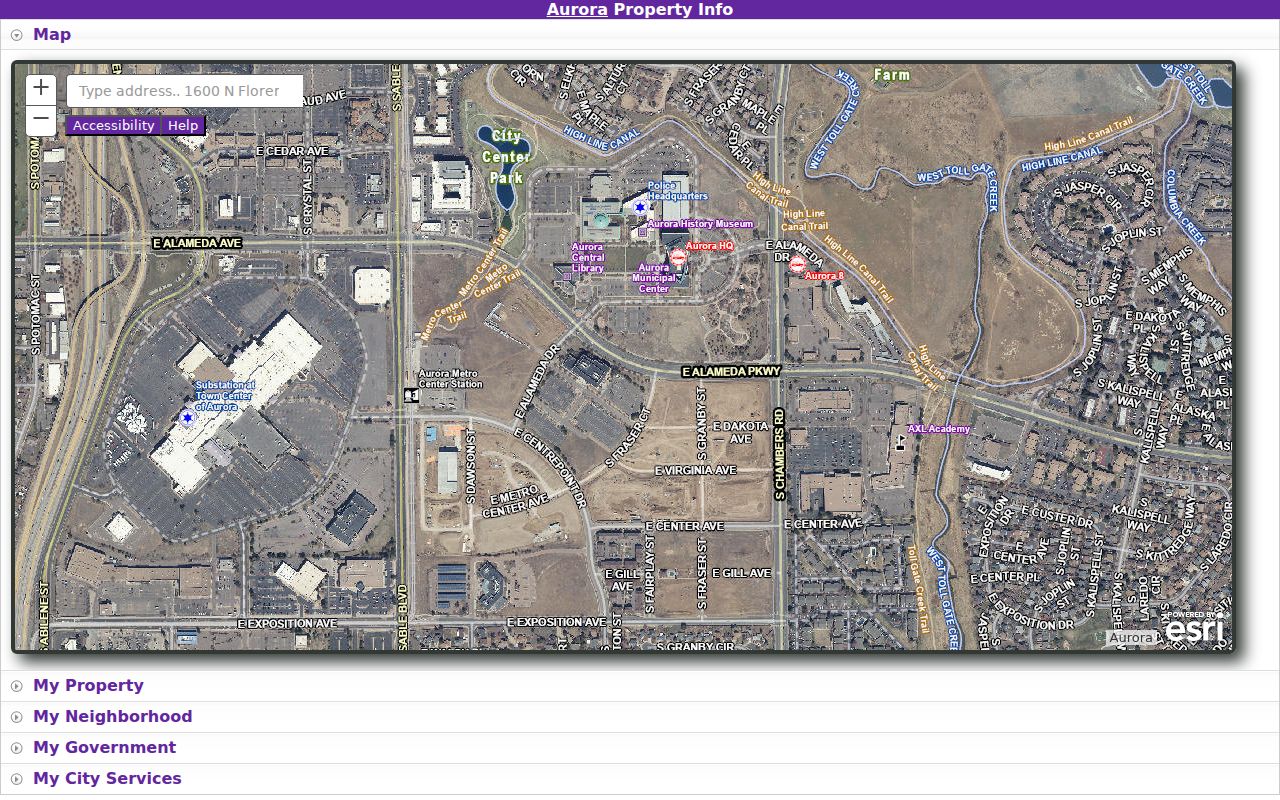
The map's categories make county, parcel, permit, HOA, neighborhood, ward, school, and document checks visible from one address, while the underlying deed and tax records remain with the county custodian.
Aurora Resident Voter Matches and Public Fields
Colorado's official voter lookup is a match tool, not a bulk resident roll. It asks for First Name, Last Name, date of birth, and residential ZIP. A successful result can route a researcher toward registration status, residential or mailing address information, precinct or district, party, county clerk, and ballot status. Use a legal name as registered and verify the residential ZIP. A no-match may reflect a name variant, another county, a protected status, or a submitted combination that does not match. It does not prove that a person is absent from Aurora.
The Colorado Secretary of State distinguishes public and confidential fields. The public set described in the voter-data FAQ includes full name, residential address, party affiliation and date, phone if supplied, gender identity if supplied, birth year, and prior-election participation. Social Security number, driver-license number, full birth date, signature, email, and protected-voter information are confidential. A voter history shows participation, not ballot choice. People who face criminal harassment or bodily harm can use a county confidentiality process, and Address Confidentiality Program participants are excluded from ordinary voter-information release.
A larger report is a separate request. The SOS data-request form lists an EX-003 weekly statewide registered-voter list, EX-002 voter history, and other report codes. The inspected form lists a $1,000 subscription for the 2025-26 cycle and $50 per data disc for several listed reports, with mail, pickup, signature, and payment fields. Request the smallest needed scope through the SOS form or the correct county clerk. Do not reconstruct a street or block roster by scraping a person-match form.
| Search field | How the field is used |
|---|---|
| First Name | Given name used for the registration match. |
| Last Name | Family name used for the registration match. |
| Date of Birth | Match field; the full birth date is not a public voter-file field. |
| Residential ZIP | Geographic match field for the registered residence. |
The Colorado voter lookup source used for this voter-match search is shown below.
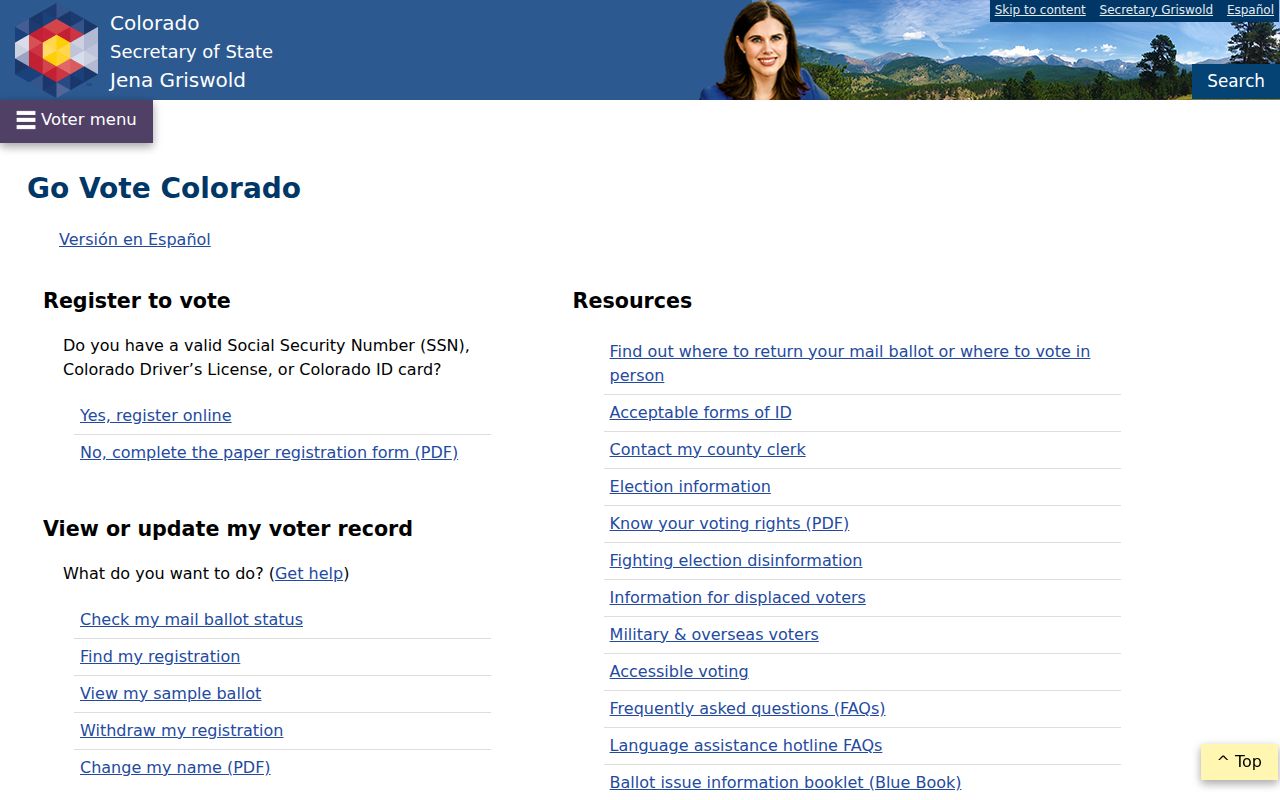
The four required fields are a useful identity check, but the public and confidential split must stay visible in any conclusion.
Current Aurora Residents Directory Sources
Current resident records are best understood as separate coverage layers. An owner record is not a resident record, and a registration match is not proof of presence on a given day. The table keeps the question, keeper, and access path together so that a resident-record result can be checked at its source.
| Source layer | Question answered | Keeper and route | Access limit |
|---|---|---|---|
| Assessor parcel card | Who is listed as owner, and what situs or mailing line follows the parcel? | Arapahoe, Adams, or Douglas assessor | Mailing line is not proof of residence; county search differs |
| Recorder index | Which grantors, grantees, liens, plats, or releases touch the legal description? | Correct county Clerk and Recorder | Images, old books, and certified copies may need office or fee service |
| Voter match | Does a name, DOB, and ZIP combination match a registration? | Colorado SOS and county clerk | Protected and confidential voters are withheld; web form is not a bulk file |
| City permits and public documents | Which permit, project, plat, or business field is tied to an address? | Aurora map, city search, or CORA custodian | Applicant or contractor is not necessarily owner or resident |
| Historical directories and notices | Was a subscriber, householder, business, or institution listed at an address? | Library, museum, DPL, LOC, CHNC, or archive | Year, geography, OCR, and subscriber coverage vary |
The assessor and recorder are the strongest current property trail. The voter tool is a person-match clue. City records add a project or address timeline. The library and archive layer can explain a former resident, a family connection, or a street label that no longer fits. A question about one person needs a separate verification pass, while the Aurora street directory keeps the address chain in parcel order.
The Arapahoe parcel card source used in the image row below accepts AIN, PIN, and address modes. It can expose an owner, mailing address, situs address, legal description, parcel identifiers, value and tax context, and map links after a result. The portal's address mode is not the preferred assessed-property route, so use the AIN or PIN when possible.
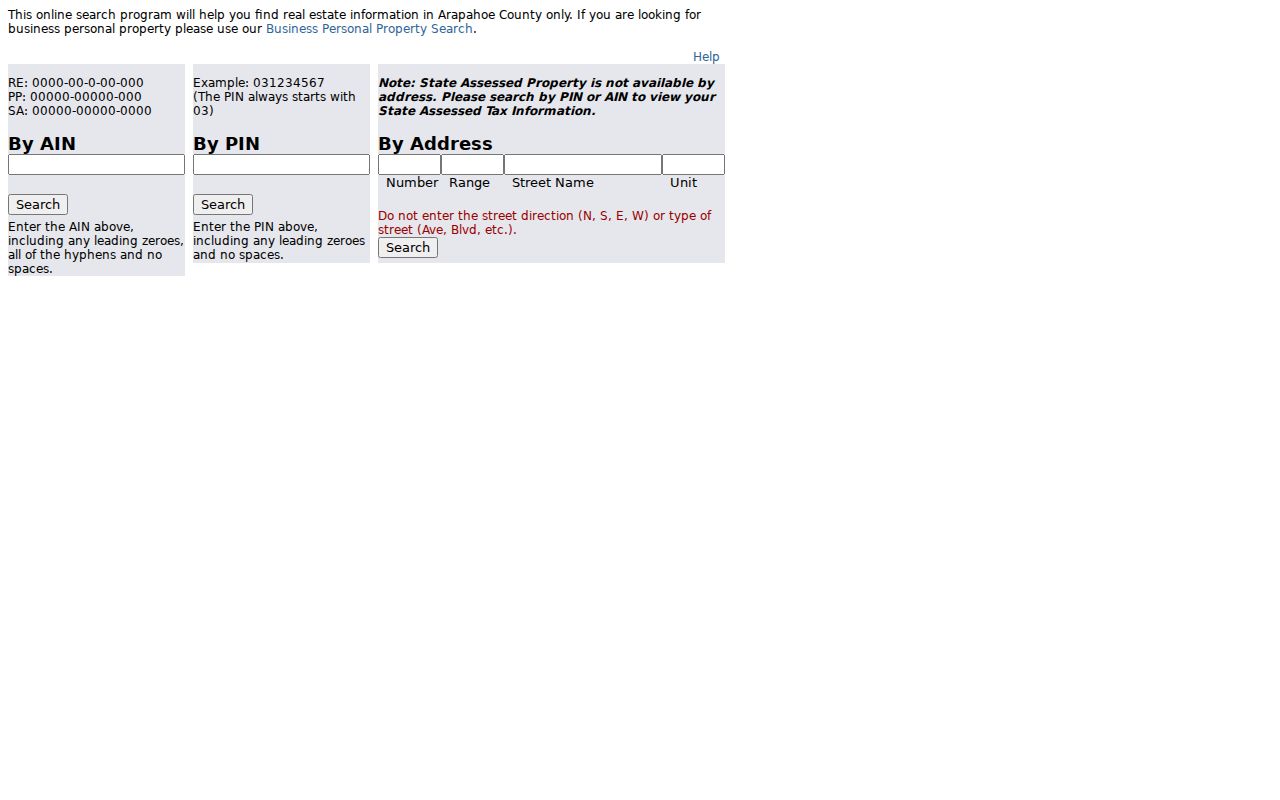
The county parcel layer supplies the identifier needed to cross from an address clue to a legal-description and recorder search.
Arapahoe, Adams, and Douglas Deed Trails
The correct recorder depends on the parcel, not just the word Aurora. Arapahoe's Official Records Search offers Quick Search and Advanced Search for Real Property. Its visible options include grantor or grantee, subdivision, document type, document number, recorded-date range, preset ranges from the last 24 hours through one year, a custom range, and Search Index Only versus Search Index and Full Text using OCR. The portal displayed verification through July 29, 2026. The historical starting year was not displayed in the inspected official material.
A chain starts with the parcel legal description or AIN. Search the present owner as grantee, open the purchase deed, identify the seller as grantor, carry forward the lot, block, subdivision, or other legal-description language, and search that seller as the next grantee. Repeat while checking reception or instrument numbers, recording dates, deed type, liens, releases, easements, deeds of trust, quitclaims, and estate or personal-representative instruments. A name-only result is a lead, not a chain.
Adams County's LandmarkWeb supports Name, Document, Book/Page, Consideration, Record Date Range, Reception Number, and Legal Search, with non-watermarked online copies available without a login and certified copies through the office. Douglas County's LandmarkWeb uses similar modes with Instrument Number, indexes names Last, First, and warns that street addresses are not indexed. Douglas recommends one-to-five-year date ranges and identifies research stations with some 1800s material. Adams and Douglas assessor and recorder portals must be used for their respective Aurora parcels.
The Arapahoe official-records index source is shown here.
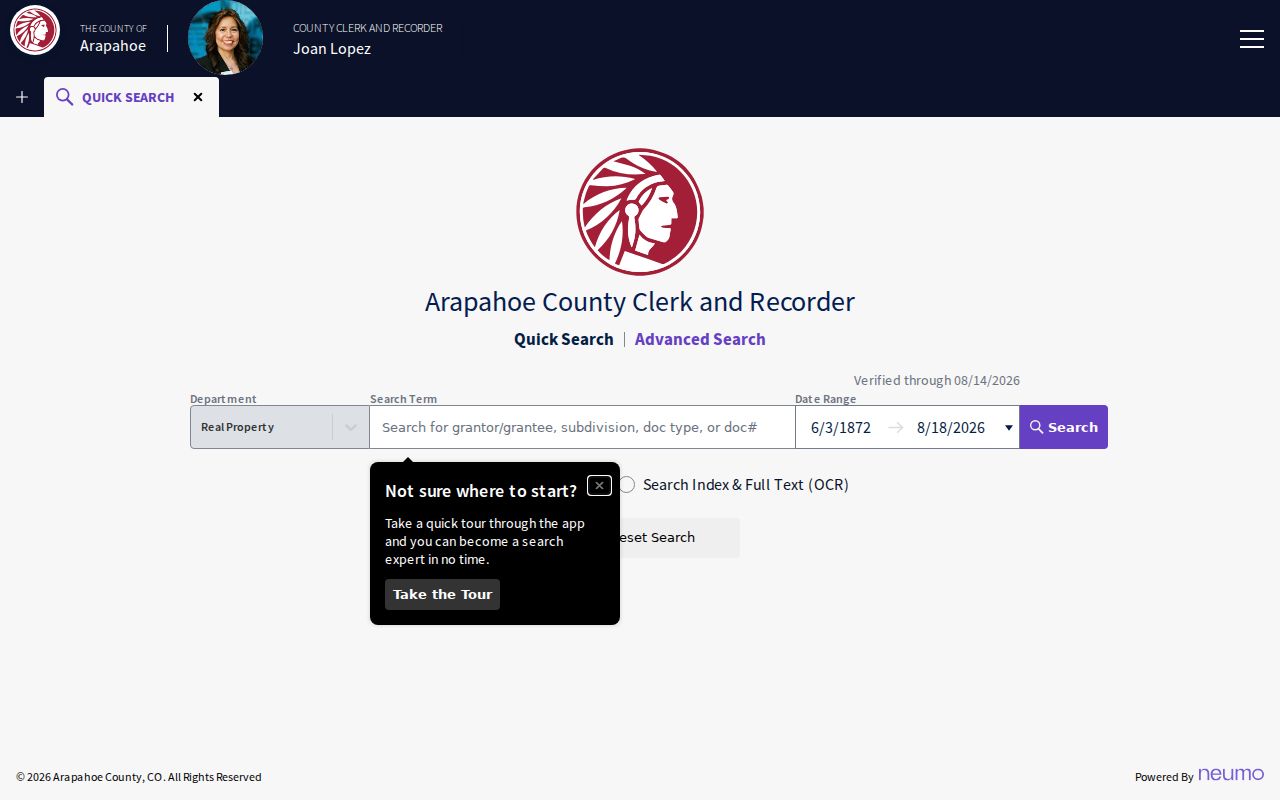
Exact live result fields and a stable named deed row were not exposed in the inspection, so reception number, party, date, legal description, and image details must be read from the current result rather than guessed.
Aurora Resident Court Dockets Need Context
The Colorado Judicial docket search can be a useful name clue, but it is a hearing schedule and docket view, not a complete case file. The portal offers Judicial District, County, Courthouse, Court Type, Division, Date Range, a specified date, case year, Case Class, Case Sequence, Individual or Business party, First Name, Last Name, Business Name, Attorney Name or Bar Number, Attorney Bar Number, Attorney First Name, and Attorney Last Name. At least one additional filter beyond date is required. Results show date and time, duration, displayed name, case number, hearing type, location, appearance type, and courtroom, with export and printable controls.
A no-result search does not establish that a person has no case. Try the county that holds the Aurora parcel, a broader date range, a case class, and name variants. Then request the register or filed record from the clerk. The inspected Arapahoe sample included a hearing labeled Arapahoe County - Aurora, while other rows used Arapahoe County alone. The courthouse label does not prove where a party lives. Arapahoe court records requests can be sent through the form or web route, with requester, case, county, party, record type, certification, and delivery fields. The form states a 3 to 5 business-day response and lists copy, search, research, and certification fees under CJD 06-01.
Aurora Municipal Court is separate and handles municipal violations. Its public information page lists the court route, detention information, and published phone contacts. Adams County courts use the 17th Judicial District, Arapahoe the 18th, and Douglas the 23rd. The right county and venue should be identified before a docket is treated as part of an Aurora records search.
The official Colorado Judicial docket screen documents the filters and result columns described above.
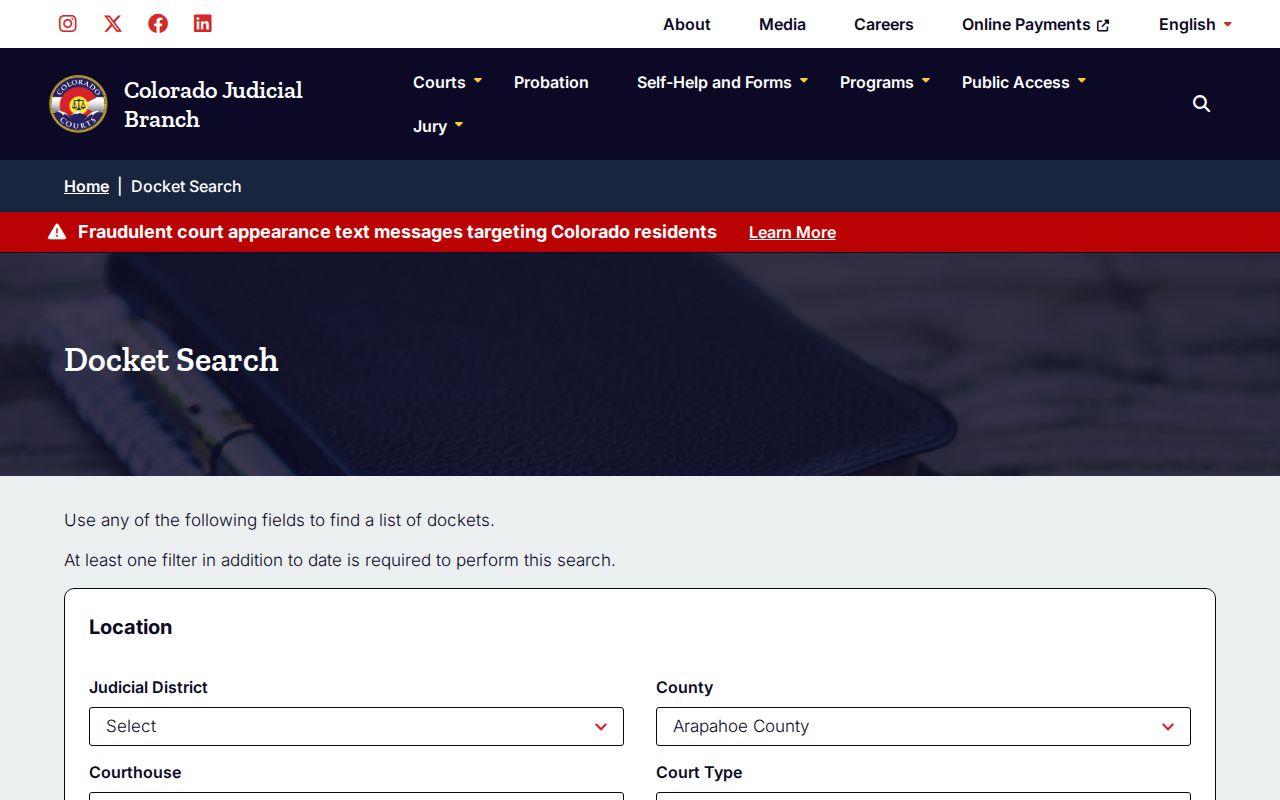
Keep the case number, year, court, and case class with any name match, and obtain the clerk-held record before drawing a conclusion.
The Aurora municipal court and detention route is shown separately in the next source image.
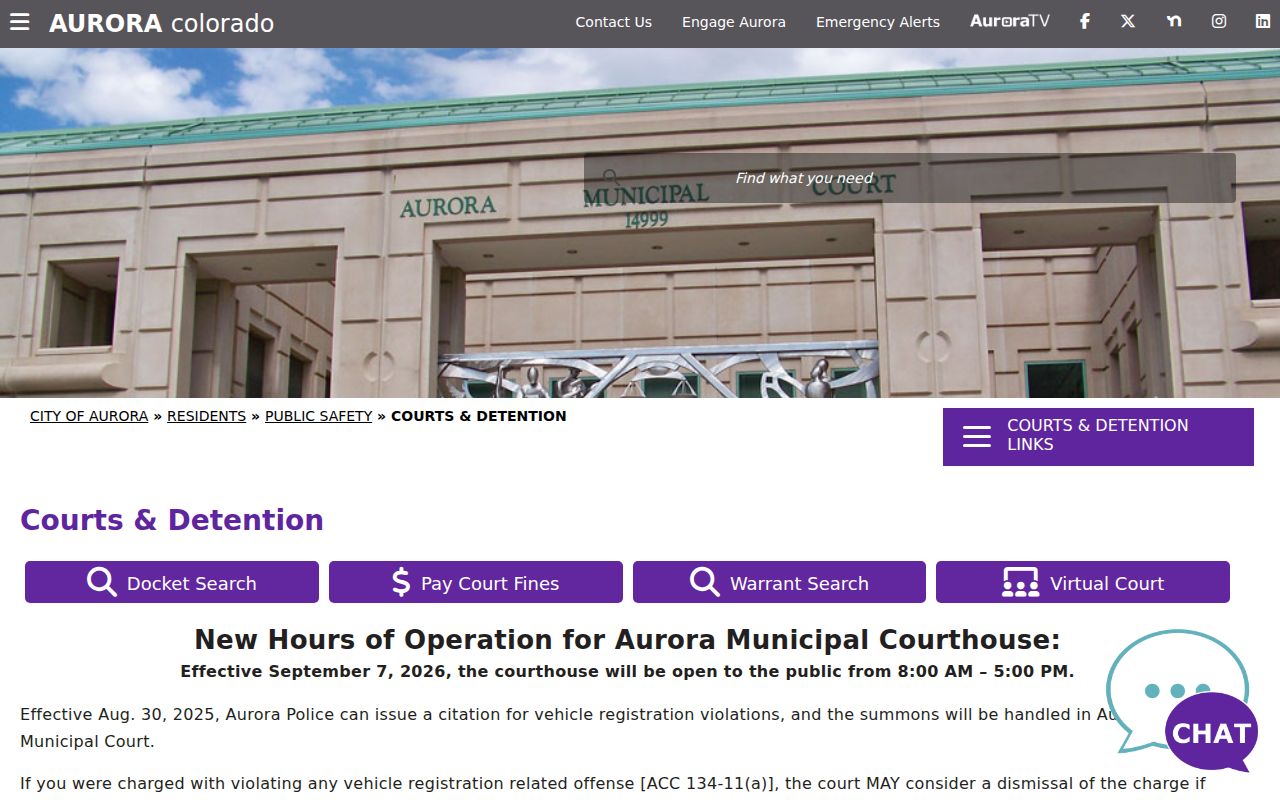
The municipal route does not replace county, state, or federal court searches, and a custody or warrant result is a limited snapshot.
Aurora Vital Records Have Narrow Access
Birth, death, marriage, civil-union, divorce, and adoption records are not a public name directory. Colorado's vital-statistics law, C.R.S. §25-2-117, treats vital statistics as confidential and allows a certified copy for an applicant with a direct and tangible interest under the statute and program rules. The inspected law did not provide a simple rule that every record becomes open after a set number of years. Eligibility, identity, relationship, and record class control the route.
The Colorado Department of Public Health and Environment order route lists standard and heirloom birth certificates, standard death certificates, marriage or civil-union verification, and divorce verification. Applications can require applicant contact information, the subject's name and event details, relationship or eligibility category, photo ID, proof of direct and tangible interest, delivery details, and payment. Fees are nonrefundable. The inspected page displayed about 30 business days for normal online processing and appointment-only in-person service with no walk-ins. Local county offices may issue eligible birth or death copies, the county Clerk and Recorder handles marriage or civil-union licensing, and the district court holds divorce files.
Colorado State Archives is a different access layer. Its birth-record guide says birth and death holdings are generally at least 100 years old and that post-1908 records usually remain with CDPHE. Adams and Arapahoe guides contain older county material, including early birth and death registers, cemetery plot certificates, and coroner inquests. Archives requests go to the Denver location and should be framed as a historical record request, not a current-person search. Adoption records use the Voluntary Adoption Registry and confidential-intermediary routes, not a public parent-child index.
The official Colorado vital-record order route is represented in the local records source image.
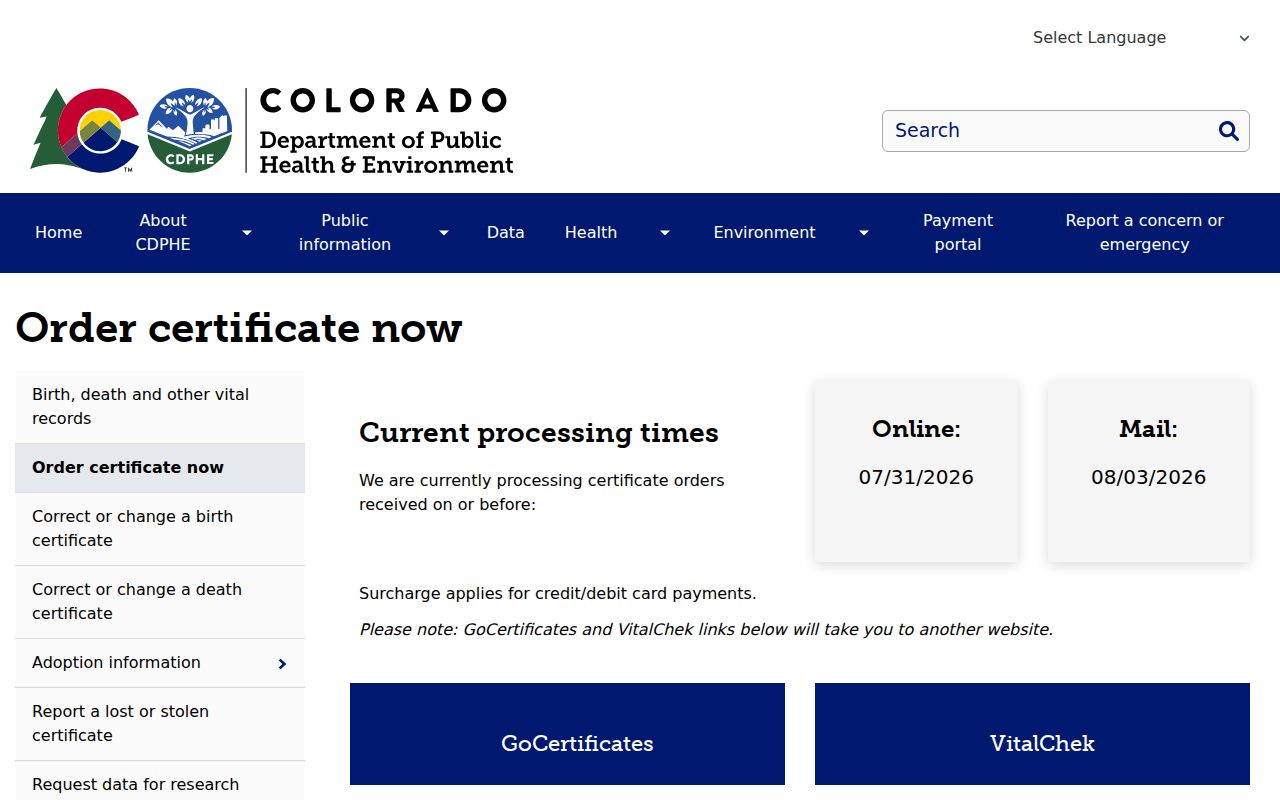
An obituary, directory entry, or court docket can suggest an event, but it does not substitute for an eligible certified record.
Aurora Records Requests Through CORA
Aurora city records that are not exposed in a portal can be routed through the Aurora public-records page and the city's CORA NextRequest portal. Colorado Open Records Act requests use C.R.S. §24-72-102 et seq.; public-safety material also involves the Colorado Criminal Justice Records Act, C.R.S. §24-72-301 et seq. The city policy calls for a specific written or NextRequest request, not a verbal or social-media request. State the department or custodian, record type, address, parcel, case, permit number, date range, and preferred electronic format.
Aurora's policy gives a normal three-working-day response and permits a seven-working-day extension for an extensive request. Electronic release is preferred. The inspected policy lists $0.25 per physical page, $41 per hour after the first hour for research, retrieval, or review, and a possible 50 percent deposit for a request expected to exceed $100. Redaction can apply to personally identifying information, confidential or privileged material, and other exemptions. The city does not create a new record just to answer a question.
The city request form inventory includes account or requester information, department, subject, detailed record description, address or parcel, case or permit number, date boundaries, preferred format, attachments, notification fields, status messages, and released-document downloads. Exact labels and required markers were dynamic in the inspection. For police or 911 records, use the separate custodian and the CCJRA route. County deeds, assessor cards, court files, and vital records remain with their own offices even when an Aurora address appears in the request.
The Aurora public-records routing source is shown below.
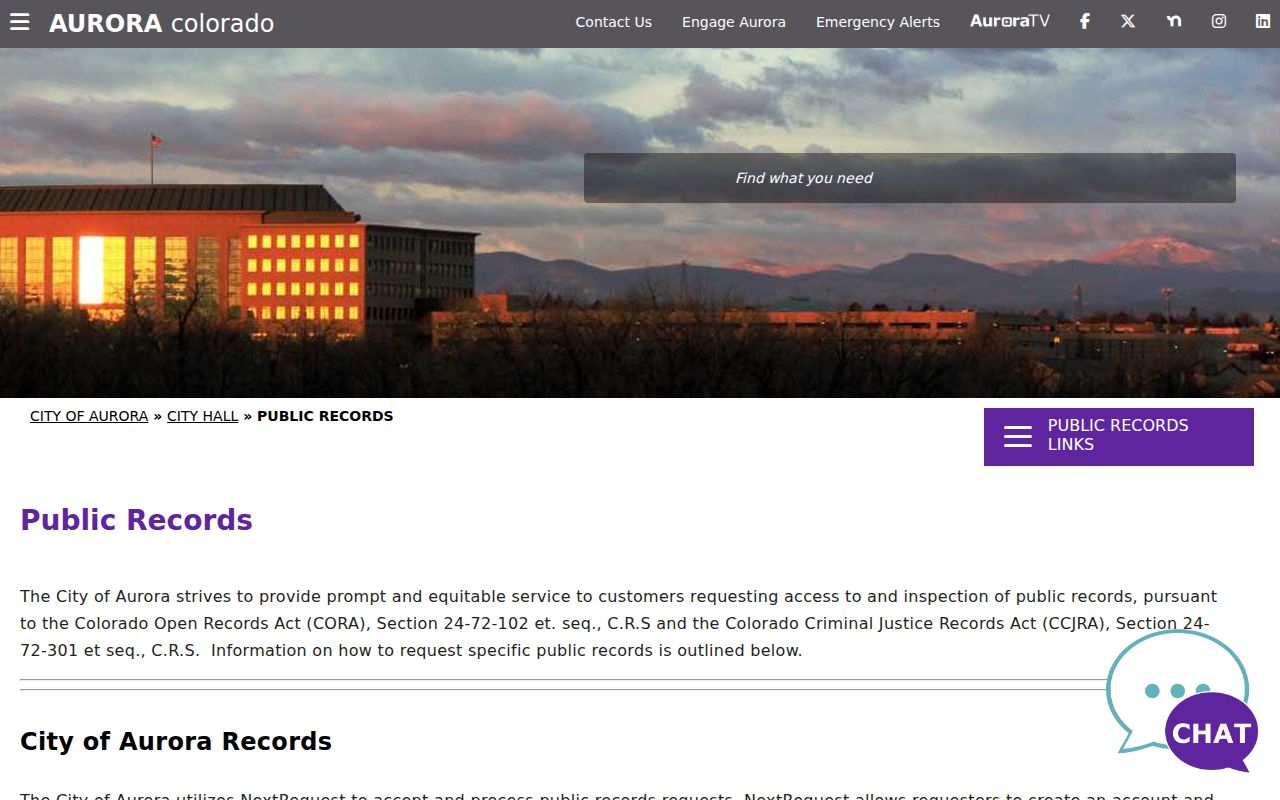
A narrow address and date request gives the custodian a usable record key and reduces the chance of an accidental disclosure.
NextRequest supplies the city account and submission route for a written request.
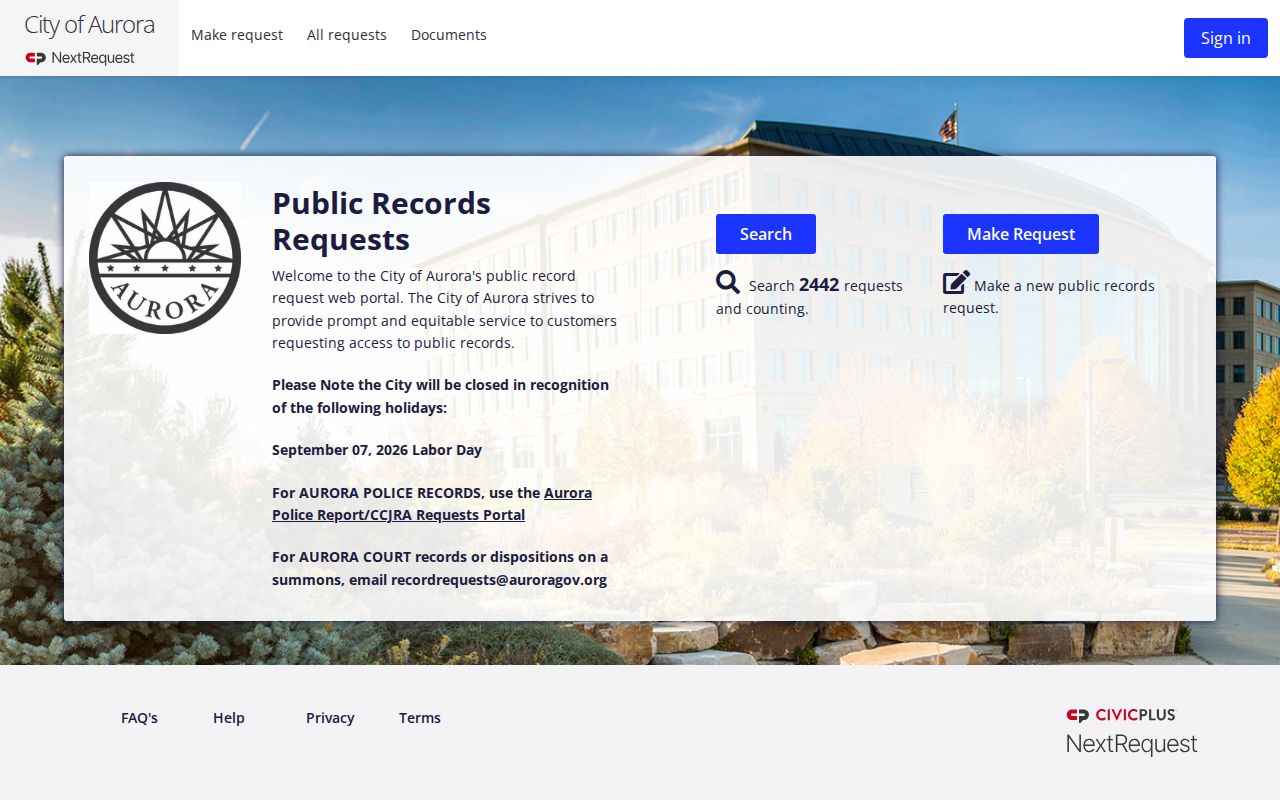
Released files still need to be read for redactions, source office, date, and record type before they are used as resident evidence.
Aurora Records Compared by Purpose
Official records and compiled people-finder services answer different questions and carry different levels of proof. An official index is closer to the originating event, but it may be narrow, incomplete, delayed, or restricted. A compiled service may collect many public fragments, yet the result can merge names, retain stale addresses, or omit protected people. The safest comparison is by source and claim, not by the number of lines returned.
| Route | Best use | What it can establish | What still needs checking |
|---|---|---|---|
| County assessor or recorder | Parcel and ownership history | Tax-roll owner, legal description, parties, dates, recorded instruments | Residence, household members, missing older images, county boundary |
| Colorado voter lookup | One registration match | Name, DOB, ZIP combination and public registration fields | Protected status, physical presence, full voter file, ballot choice |
| Library, museum, or archive | Historical people and address research | Listed subscriber, household, notice, image, or institutional context | Publication geography, OCR, unlisted people, current status |
| Compiled search service | Unverified lead generation | Possible public-record fragments and name variants | Origin, freshness, identity, corrections, and lawful use |
When an official source is silent, document the exact search mode, date, county, and access gap. A no-result statement is only as strong as its route.
Key Aurora Directory Terms
Several record words carry more weight than they appear to. Define them before combining a parcel, name, and date in a local records search.
- Roll
- A recurring list kept for a purpose, such as the assessor's tax roll or a voter registration report. A roll has inclusion rules and does not list everyone in a city.
- Index
- A finding aid that points to a record or image. An index row is not always the full instrument, certified copy, or unredacted file.
- Parcel
- A legally described piece of land identified by an AIN, PIN, lot, block, subdivision, or other stable land key.
- Criss-cross directory
- An address-order or householder-style directory that can move from a street address to a listed occupant or owner for a covered year and geography.
- Situs address
- The physical location of a parcel or structure. It can differ from the assessor's tax mailing address or the USPS city and ZIP last line.
Keeping these definitions visible prevents an owner name from becoming an unsupported resident claim and keeps a historical listing in its publication year.
Historical Aurora Residents Directory Collections
The strongest fully digitized local anchor is the Library of Congress Aurora telephone directory, covering Winter 1936/37 through May 1947 with white and yellow pages, text, images, and PDF access. A local entry can include subscriber or business name, telephone number, street address, and classification context. The OCR sample “Allen Frank R | r | 10355 E 23d av. | Aurora-209” shows why the image matters: columns and abbreviations can be damaged in text.
Aurora History Museum survey bibliographies identify a 1930 Annual Directory, 1939 Aurora Telephone or Mountain Bell, 1941 XL Directory of Aurora Section B, 1948 Complete Directory of Aurora, 1952 Aurora Directory, and Aurora citations for 1953, 1955, 1957, 1959, 1962, plus a 1972-73 Denver Suburban Directory. Publishers include XL Directory Service, Powell Advertising Sales Agency, Loveland references, and R.L. Polk. A citation proves a year and title were located or used for a survey, not that a free scan exists. The complete year-by-year shelf and entry-reading method lives on the Aurora city directory page.
The Aurora library gateway connects Colorado Historic Newspapers Collection, which contains more than 750,000 pages from 199 titles dated 1859-1923, along with genealogy, history, and newspaper databases. Denver Public Library holds Colorado obituary scrapbooks from 1934-1963 and regional directory indexes, but a Denver volume must be checked for its municipality and suburban boundary before it is treated as an Aurora city directory.
The Colorado Bureau of Investigation registry source is shown in the final source image as a separate, bounded lookup that can sit beside historical research when the question calls for it.
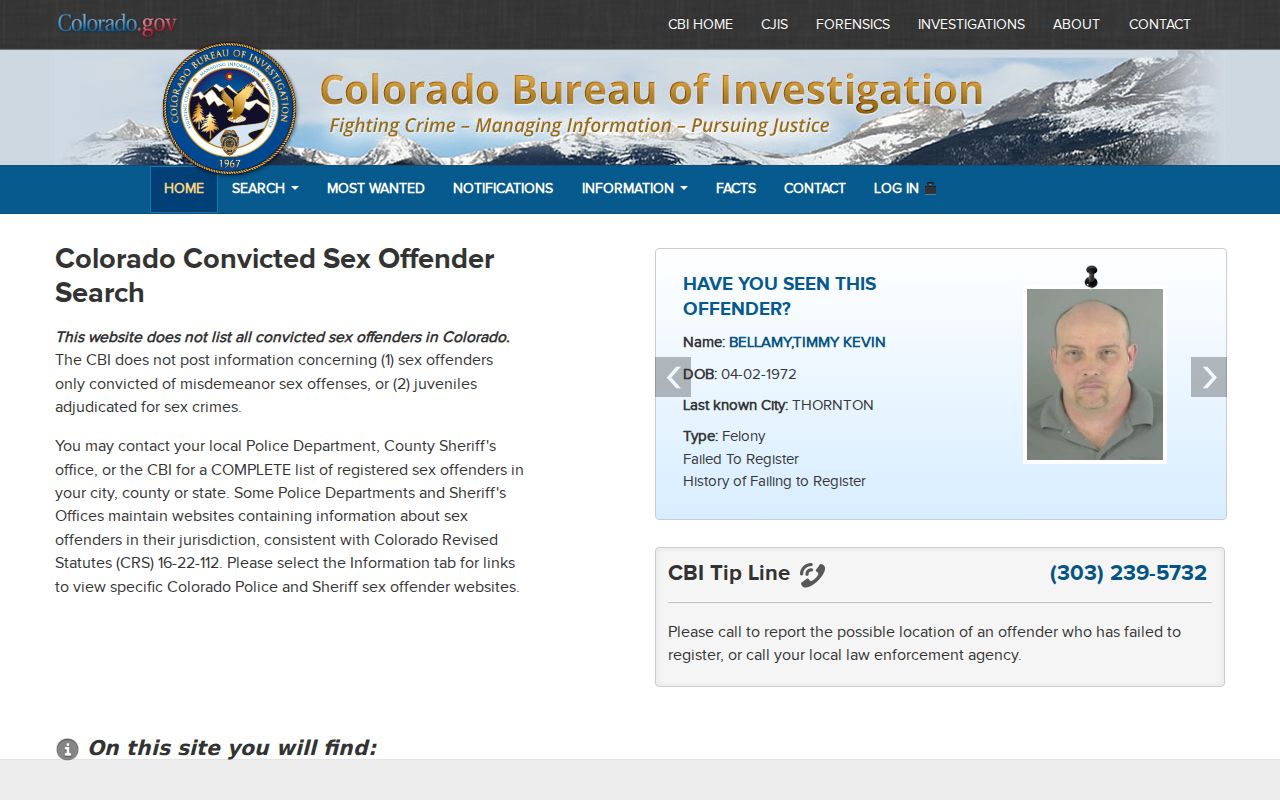
The Colorado Bureau of Investigation registry covers qualifying records only, updates hourly, and is not a complete criminal history. It belongs in a narrow official-record check, not in a claim that a historical directory or current resident list is complete.
Aurora's Archive Trail Tells a Story
Aurora's record history is unusually distributed. The first public library operated from Sarah Wood's home at 1516 Dallas Street on February 10, 1929. The city's library history says an organized city-record preservation program did not begin before 1977, and that the library assumed responsibility for archives in 1985. That history explains why a researcher may need the city map, a county recorder, a library database, a museum finding aid, and a state archive for one address rather than finding a single continuous resident roll.
The record trail changes with the era. Fletcher became Aurora in 1907 after early trolley and rail growth, while the 1926 Sanborn map, the 1936/37-1947 telephone run, the Hoffman Heights bibliography, later suburban directories, census releases, GIS, ArcGIS layers, dockets, voter verification, and NextRequest each preserve a different kind of clue. The 1950 census is available under the 72-year rule; the 1960 census was not yet released at the August 2026 inspection. Pair a directory year with the nearest available census, then test the address with a deed, newspaper, obituary, or museum record.
For missing years, use precise language: not digitized, not held, dynamic, or not located in the inspected official material. A blank year is not proof that no record existed. The museum's supervised appointments, finding aids, research requests, and reproduction service can fill a local-history gap, while a library, the Aurora Genealogical Society, FamilySearch Center, or State Archives can point to a different repository.
Aurora Records Stop at a Privacy Boundary
An Aurora residents directory cannot show every person associated with an address. Private utility and delivery lists, DMV address information, complete unit-level household lists, and protected voter information are not general public layers. Vital records are confidential. Juvenile, sealed, suppressed, expunged, adoption, and protected domestic material may be withheld or redacted. The Colorado Address Confidentiality Program provides eligible participants with a substitute address and confidential mail forwarding, and protected voters can be excluded from ordinary voter release.
Lawful personal use. Public records support genealogy, civic research, property history, reconnection, and verification of a specific source. Do not use an address or person record to stalk, harass, threaten, monitor, or harm anyone. If a search touches a safety concern, stop and use the appropriate official support or law-enforcement channel.
The Colorado Privacy Act can provide access, correction, deletion, portability, and opt-out rights for covered personal-data processing, but public records held by government are excluded from the Act's personal-data definition described by the Attorney General. A privacy request to a compiled provider does not erase a county deed or court index. Corrections and confidentiality questions belong with the originating assessor, recorder, clerk, court, election office, or vital-record custodian.
That boundary is part of an accurate Aurora residents directory. A careful result says what source was checked, what the source covers, what date it reflects, and what it cannot show.
Aurora Research Stops Before Harm
Aurora's municipal court posted a January 6, 2025 scam alert about impersonators who claimed to be probation or court officers, threatened a warrant or arrest, and demanded gift cards or wire payments. The court says its staff will not call to collect a fine without written documentation or request a street, store, or jail cash payment. The safest check is to navigate to the official agency domain and use the published phone number, not an unexpected message link.
Use the same care with a deed-copy letter, a court text, or an unclaimed-property message. Ask for the record type, parcel, case, reception number, fee, and official payment route. Keep a request log and verify a payment demand with the relevant custodian. An Aurora residents directory is a research aid, never permission to confront, monitor, or expose a person.
When a source is unavailable, the honest endpoint is an access channel: county counter, assessor or recorder phone, clerk email, mail request, court form, library microfilm, museum appointment, State Archives request, or a narrow CORA/CCJRA submission. The record may remain outside the web, but the route to the custodian can still be documented.